Sponsored By
ADVERTISEMENT
ADVERTISEMENT
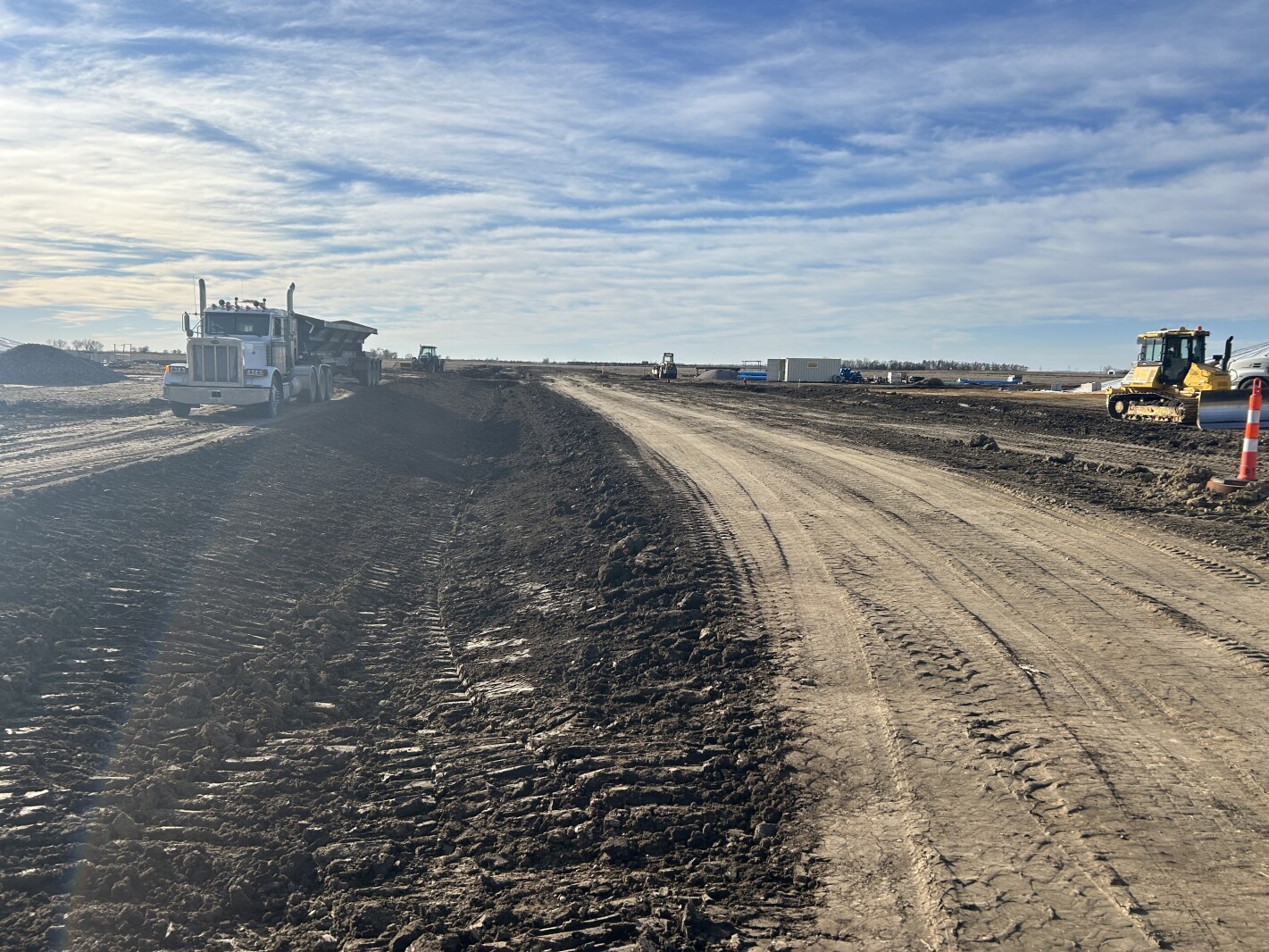
PARKSTON, S.D. — Trucks are already moving and new construction is visible south of town, marking a period of industrial activity not seen in Parkston for years. And it’s all thanks to a new development that combines private investment with public infrastructure planning.
The project is the Trojan Business Park, a 42-acre commercial and industrial site led by the Parkston Area Development Corporation (PADC). The park is designed to host up to 11 businesses, including light manufacturing and value-added agriculture operations.
ADVERTISEMENT
The total project cost is $6.65 million, with $4.96 million funded through a Tax Increment Financing (TIF) district approved by the city. The TIF covers infrastructure improvements, including roads, water and sewer lines, land acquisition, and professional fees. Interest payments on associated loans are projected to reach approximately $1 million.
Drew Muntefering, president of PADC, said the TIF was essential for the project.
“A development of this magnitude is only feasible in a town like Parkston because of this financing,” he said. “A private developer simply couldn’t shoulder the upfront risk and cost.”
The park was prompted by plans from Lance Thury, owner of Kaylor Agri-Services, to build a fertilizer plant and soybean roasting facility across Highway 44 from his main office. The Development Corporation expanded the effort into a 42-acre business park, leveraging the guaranteed investment.
“Instead of letting Thury build in isolation, we asked, ‘What do you think about us buying more and then adding on to that?’” Muntefering explained.
Phase 1 of the park is largely complete. Water and sewer lines have been bored under Highway 44 and are being sanitized, roads for the initial area near the Kaylor facilities have been constructed, and drainage ditches are in place. Lots are ready for new businesses to break ground as early as this spring.
Tim Semmler, Parkston’s mayor, said the project made sense from a practical standpoint.
ADVERTISEMENT
“Because Thury’s facility was coming into city limits, the municipality was obligated to provide water and sewer,” he said. “It made sense to put the capacity in now to serve him and future businesses rather than digging it up later.”
Kaylor Agri-Services, a regional agribusiness, has already begun operations in the park. The fertilizer plant opened in July, followed by the soybean roasting facility, which began processing in October. The expansion consolidates operations that had outgrown a landlocked downtown site and allows the company to operate more efficiently near its main office.
The project is projected to bring $24.7 million in private investment over the next five years, including $14.75 million in taxable capital investment, and is expected to create more than 17 full-time equivalent jobs. Kaylor Agri-Services, which has grown from 8 employees to nearly 80 over the past 20 years, serves as the anchor for the current expansion.
Additional development is also planned within the TIF district. Jensen DesignBuild is preparing a 12-unit apartment building, and Rexwinkel Properties will construct business condominiums. These projects aim to provide housing for the workforce while adding commercial space for smaller enterprises.
The financing structure for the project is multi-layered. While the TIF covers the majority of infrastructure and land costs, interim financing came from East River Electric’s REED program and Dakota Resources, both providing low-interest capital, and Farmers State Bank of Parkston, which offered bridge financing. Grants are also being sought from the Department of Transportation and the Governor’s Office of Economic Development to fund turning lanes off Highway 44, required due to increased truck traffic.
Parkston has used TIFs in the past for both industrial and housing projects. A TIF created by Hutchinson County in 2012 helped finance a $1.99 million expansion for Parkston-based MDS Manufacturing, including critical infrastructure improvements, and has generated $1.69 million in incremental taxable value as of 2024, according to the South Dakota Annual Report on Tax Increment Financing.
Another TIF in 2019 supported a $993,275 housing project, which included business condominiums and duplexes, generating $1.8 million in incremental taxable value.
ADVERTISEMENT
Dave Lambert, director of regional development at Dakota Heartland Development Association, said TIFs are crucial for rural economic development.
“If a town isn’t growing, it’s dying,” Lambert said. “The goal isn’t for towns and development corporations just to hold on to money or land—it’s to create jobs, investment, and sales tax revenue. That’s what TIFs make possible.”
Parkston’s current development represents a shift from the town’s historically conservative approach. After roughly a decade of limited growth, town leaders are pursuing expansion across industrial, residential, and infrastructure sectors. Lambert describes the approach as a “grow or die” philosophy, noting that population and business growth had been flat for probably a decade or more. Muntefering emphasized that looking toward the future is necessary to attract fresh workers and families, sustaining the town over the long term.
The Trojan Business Park is the most visible sign of industrial growth. The last industrial park of comparable size in Parkston was developed 20 to 25 years ago along Ben Street. The 2012 TIF that helped bring MDS Manufacturing into city limits and upgrade its sewer infrastructure was a single-site project rather than a broad development area.
Housing development has also become a priority. Lambert noted that in the last five years, roughly half of his work has shifted to affordable housing, emphasizing that businesses cannot recruit employees if there is nowhere for them to live. Parkston is addressing this through the 2019 residential TIF, private investment such as a new subdivision from Ethan Co-op Lumber, and the planned 12-unit apartment building by Jensen DesignBuild, the first new apartment construction in more than 20 years.
Town leadership points to core amenities as enablers of growth. The hospital, school, and grocery store provide a foundation for community sustainability, Semmler said, and the town recently completed a $10 million reconstruction of its airport, further modernizing infrastructure to support ongoing development.
Semmler said the combination of industrial, residential, and infrastructure projects reflects a deliberate strategy to maintain workforce capacity and local services.
ADVERTISEMENT
“Stagnation is fatal for small towns,” he said. “This isn’t just about businesses; it’s about keeping our schools and hospital viable and bringing fresh energy to Parkston.”
ADVERTISEMENT
ADVERTISEMENT