Please enable JavaScript in your browser for better use of the website.
Nine French associations working with people camped in northern France have issued a statement condemning the UK and French governments for their lack of action against anti-migrant vigilante groups. They say these groups are “encouraging violent and xenophobic practices.”
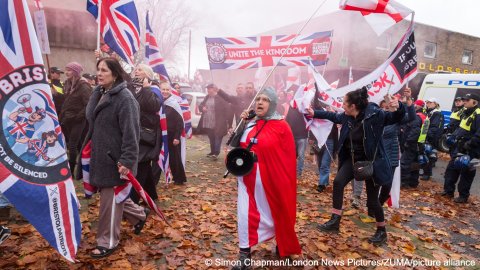
Recently, a movement dubbed “Operation Overlord” was launched by members of British groups involved in vigilante actions to try and stop the boats. Members of this operation left the United Kingdom, with the singular aim of patrolling the French coastline to “stop the boats,” the small vessels boarded by migrants attempting to enter Europe by crossing the English Channel.
On their social media page, the groups post videos where they can be seen “stalking the dunes” and looking for migrant boats and dinghies to destroy. When they are successful, they hoist a Union Jack flag on the site, declaring their victory. According to reporting by the British newspaper The Guardian, the group has been harassing migrants and roaming coastal areas to look for boats, despite having no authority to do so.
One of the groups calls themselves Raise the Colours. They are one of the many anti-migrant activist groups spreading across Europe at the moment. Their rising prominence is concerning to migrant support groups in France. According to The Guardian, nine French associations working with people camped in northern France have issued a statement condemning the UK and French governments for lack of action to stop anti-migrant British activists who they say are “encouraging violent and xenophobic practices.”
Their call-outs for volunteers have attracted thousands, with reportedly more than 5,500 people responding online, expressing willingness to travel to France to take part in these patrols. On their website, Raise the Colours openly solicits donations which range from 10 to 2,000 British pounds (between about 11 and 2,285 euros) to fund what they call a “civilian border control force.”
The group has also circulated requests for equipment that include stab-proof vests, plate carriers, thermal cameras, drones, encrypted radios, and high-powered torches.
Raise the Colours did not reply to an email requesting comment.
The nine French organizations that reportedly issued the statement include L’Auberge des Migrants, Utopia 56, Medecins du Monde, Human Rights Observers and the Refugee Women’s Centre. They have accused the British and French authorities of a “seriously inadequate response” to the reported arrival in France of Raise the Colours’ supporters, who they say employ “structured intimidation tactics.”
The group slammed the authorities for alleged inaction on taking down Raise the Colours’s recruitment and funding ads and denying them entry to French territory. These actions not only normalize but also encourage violent behavior against migrants and humanitarian and support organizations, they explained.
In an email to InfoMigrants, a UK Home Office spokesperson said, “We recognize the frustration surrounding small boat crossings. However, taking the law into your own hands will not resolve the issue. This week, the Home Secretary has announced the biggest reforms to tackle illegal migration in decades, to restore order and control to our borders and make it less attractive for illegal migrants to come to Britain.”
Additionally, the spokesperson also cited as background how, while the matter is principally for French law enforcement, the British government is nevertheless taking action to try and reduce the numbers of migrants arriving by small boats. “We have detained and removed almost 50,000 who were here illegally, and our historic deal with the French means those who arrive on small boats are now being sent back,” they explained.
The French government did not respond to a request for comment by the time of publication.
Raise the Colours is not the only group adopting vigilante tactics in response to migration. Across Europe, similar “migrant hunter” movements have gained traction, portraying themselves as defenders of local communities, stepping in where they claim authorities have failed. These groups typically frame migrants as threats and themselves as protectors. It is a narrative that easily taps into broader social fears and political rhetoric already dominating headlines.
The Radicalisation Awareness Network (RAN), an EU-funded initiative bringing together frontline practitioners, studied what it describes as the “growing internationalization” of right-wing extremism. Their research shows how online networks help normalize hateful narratives, particularly those targeting migrants and asylum seekers. Right-wing extremist movements in Europe, the study notes, are no longer confined to youth subcultures like skinheads or neo-Nazis. They now involve adults across age groups and professions.
RAN cited research from Norway showing a notable shift: the average age of radicalization rose from around 22 in the 1990s to 31 in the 2010s. Older individuals — with more resources, social networks, and life experience — are increasingly driving these movements.
In the UK, the anti-extremism organization Hope Not Hate has documented a sharp rise in anti-migrant activism.
In 2022 alone, migrant hunters visited asylum accommodation sites 253 times — more than double the number in 2021. These incidents, filmed and posted online, often show activists confronting hotel staff or recording asylum seekers entering and exiting buildings. According to Hope Not Hate, such videos consistently generate the highest engagement on the activists’ social media accounts, further incentivising confrontational behavior.
The group warns that a toxic mix of hotel harassment, hostile political language, and inconsistent government policy is fuelling extreme actions. The rising popularity of anti-migrant content online, they say, makes it likely the trend will continue.
To understand how groups like Raise the Colours fit into a much larger political landscape of the far-right movement, Brazilian journalist Andrea Dip told InfoMigrants about her findings that challenge the assumption that these far-right, anti-migrant movements are driven by random individuals running a chaotic or disorganized movement. Behind the viral videos and picket signs lies a structured, well-funded international network, she believes.
“They are very practical in their strategies,” Dip explains. The conferences she attended featured senior political figures, including ministers and prime ministers, and were about developing legislative tactics, mapping opposition, and planning coordinated campaigns.
A 2025 study by the European Parliamentary Forum for Sexual and Reproductive Rights (EPF) found that far-right and anti-gender groups moved more than 1.18 billion dollars ( around 1.015 billion euros) across Europe between 2019 and 2023. Nearly three-quarters of that funding came from within Europe itself, with additional contributions from Russia and American Christian-right organizations. Countries including Hungary, France, the UK, Poland, and Spain were identified as major hubs for anti-gender and far-right financing.
These networks form powerful alliances that blend religious extremism and far-right populism, pushing anti-immigrant narratives into the mainstream through media, NGOs, and political parties. Their messaging — including phrases like “Make Germany great again” or “Poland for Poles” — is intentionally designed to present exclusionary nationalism as patriotism.
While the image and face of movements such as Raise the Colours is that of middle-aged white men, Dip noted that the far-right messaging of belonging and identity masked as patriotism resonates strongly with young people navigating their own uncertainties when it comes to self-determination and identity.
In the book “Towards a Vigilant Society: From Citizen Participation to Anti-Migrant Vigilantism”, author Matthijs Gardenier examined migrant vigilanteism in Calais in France and Dover in the UK and described the movement’s core activity as a highly performative form of vigilantism, relying on dramatic patrols, calls for “self-justice,” and online harassment.
“These actions shape a worldview that recasts the situation in Calais and Dover not as a humanitarian crisis but as a battlefield, portraying migrants as “invaders” and vigilantes as heroic defenders. Although much of this vigilantism is symbolic — staged primarily for social media visibility — it still contributes to a confrontational atmosphere and, at times, spills into real-world intimidation,” wrote Gardenier.