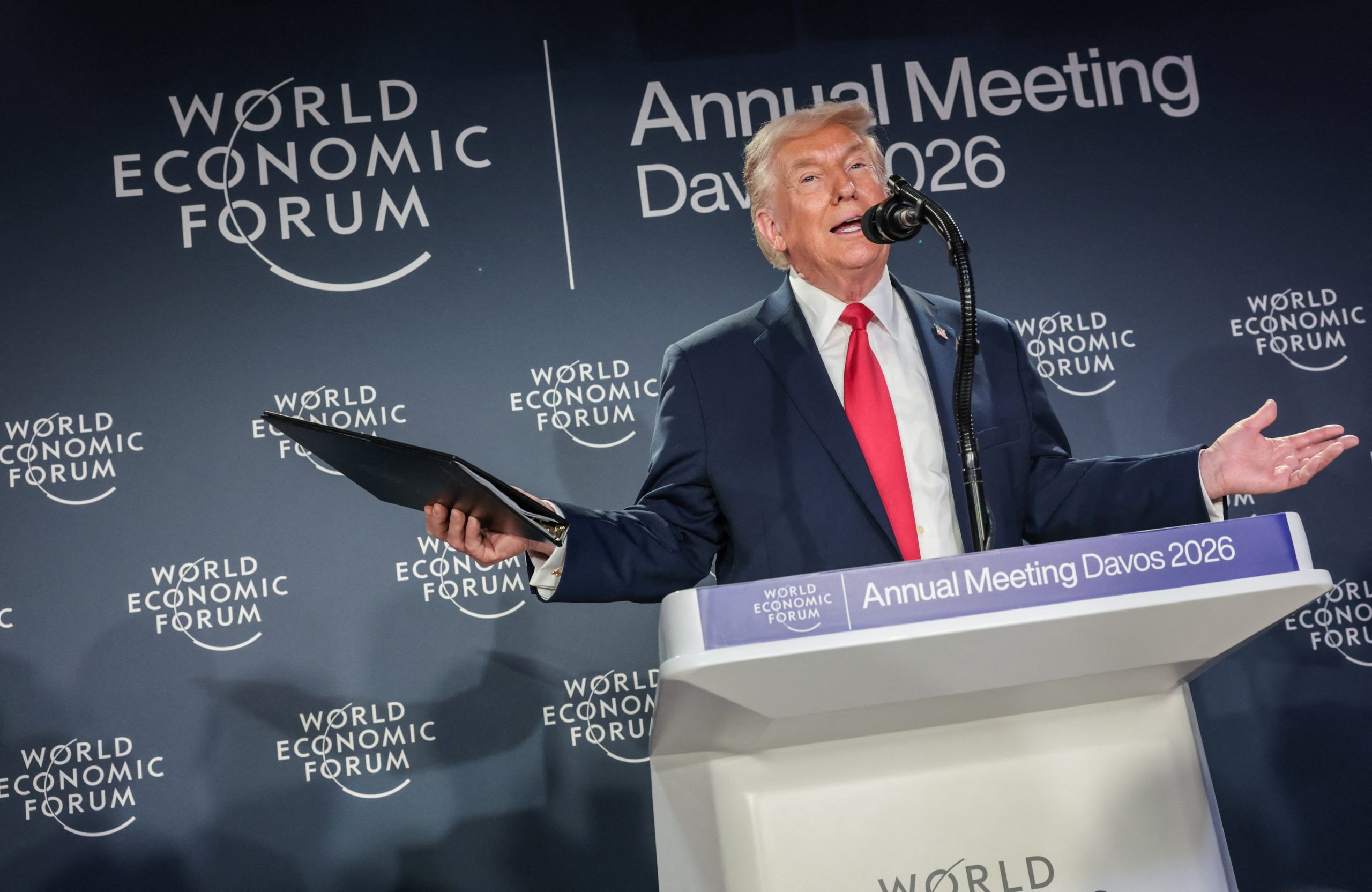
The World Economic Forum, held in Davos, Switzerland in January, made clear that multilateralism is in crisis. In the run-up, Trump withdrew the USA from dozens of international bodies, launched an illegal military strike on Venezuela and threatened NATO ally Denmark with forcibly seizing Greenland. At Davos, he launched his Board of Peace, a body under his personal control that appears to be an attempt to supplant the United Nations. Amid the disarray, China is positioning itself as an authoritarian alternative while others such as Canada are proposing more defensive versions of multilateralism. Civil society must be part of the conversation and ensure global south voices are heard.
The annual World Economic Forum (WEF) meeting in Davos, Switzerland has always been a contradictory event: this exclusive assembly of the world’s most powerful people who arrive in private jets to meet behind closed doors at an Alpine resort are supposedly helping solve problems – including climate breakdown – that affect billions with no voice in the room. This year’s meeting was no exception, but the week’s events faced an additional contradiction: over 60 heads of state and 800 corporate executives gathered under a ‘Spirit of Dialogue’ theme aimed at strengthening global cooperation to tackle transnational challenges, only to expose the deep and growing cracks in the international order.
During the session, the WEF polled over 1,300 academics, business leaders and politicians about their greatest fears. ‘Geo-economic confrontation’ topped the list, with outright war between nations second. The battle for dominance between major powers worried leaders more than the climate crisis, inequality and the spread of AI. This offered a glimpse into the thinking driving states to shift resources from social spending and international aid to build up their arsenals.
Militarisation comes as a response to the unravelling of the international order. On 3 January, Donald Trump launched an illegal military strike on Venezuela to abduct President Nicolás Maduro, widely condemned as a violation of international law. On 7 January, he signed an executive order withdrawing the USA from 66 international bodies and processes, including 31 United Nations (UN) entities, such as the UN Framework Convention on Climate Change, the UN Population Fund and UN Women. The USA is simply walking away from the multilateral system it helped build.
Trump’s approach to multilateralism is nakedly transactional. His administration engages with international processes only when they advance immediate US interests and withdraws from those that impose obligations, including climate agreements and human rights mechanisms. This disassociates multilateralism from its core principles: accountability over shared standards, equality among nations and universality. It encourages other states to follow suit, undermining the stability of international cooperation.
Trump is also slashing funding. US threats to defund international bodies have left institutions scrambling. UN development, human rights and peacekeeping programmes all depended heavily on US financial contributions. The World Health Organization faces shortfalls that threaten its ability to respond to health emergencies because the US government quit without paying its overdue contributions.
Trump has put pressure on the North Atlantic Treaty Organization (NATO), the military alliance the USA founded after the Second World War. He threatened NATO member Denmark with 25 per cent tariffs unless it agreed to the USA’s purchase of Greenland and suggested he might seize the territory by force.
NATO’s Article 5 on collective defence — which states that an attack on one member is an attack on all — has been invoked once, by the USA, in the wake of the 9/11 attacks. Now the USA has cast doubt on this provision by threatening military action against allies, sending shockwaves through the alliance. European states are reacting by seeking strategic autonomy, focusing on building up their economic and military security. Despite rhetoric about defending the rules-based order, European states are slashing development aid and reducing UN contributions, claiming budget constraints, while finding extra billions for military spending.
Trump has made clear he considers himself above international law, declaring he needs only his questionable morality as a guide. Faced with this lawlessness, many states and corporations are choosing appeasement.
Other states are trying to exploit the opportunity. At Davos, China positioned itself as the grown-up alternative to Trump, promoting its Friends of Global Governance initiative, a group within the UN of 43 mostly authoritarian states, including Belarus, Nicaragua and North Korea. This is a vehicle for China’s Global Governance Initiative, which asserts a vision of international cooperation where state sovereignty is paramount and what’s described as interference in internal affairs isn’t allowed.
The queue of heads of government going to meet China’s leader Xi Jinping shows that many states are making the pivot to China amid mounting chaos. This comes at a cost: in China’s vision, there’s no room for international scrutiny of human rights performance or cooperation to promote civil and democratic freedoms.
Canadian Prime Minister Mark Carney, one of several who’ve made the recent trip to Beijing, made the headlines for his Davos speech, in which he bluntly declared the old order to be over and called on middle powers like Canada to band together or risk being eclipsed by the biggest powers. He got a good press because he was seen as standing up to Trump and because his words resonated with what many were thinking: that geography and historic alliances no longer guarantee security. He also admitted something civil society has long known: the rules-based international order was always partly a fiction, maintained by wealthy states that benefited from power asymmetries. Carney championed multilateralist rather than isolationist responses to great power competition, urging the formation of coalitions on different issues around shared interests and values.
But Carney’s approach was essentially defensive, seeking to protect the current power and position of Canada and similar states, and marking a retreat from the principle of universality in favour of ad hoc coalitions of willing states. He said nothing about the role of civil society and global south states, even though they bring crucial perspectives on issues from accountability for mass atrocities to climate adaptation funding. Any multilateral attempt to counter Trump’s influence should amplify global south voices rather than sideline them in favour of middle power interests.
Trump’s presence loomed over Davos even before he arrived with the largest US delegation the forum has ever seen. His threats to acquire Greenland sparked emergency talks. But a unified pushback forced Trump to change course: alongside NATO Secretary General Mark Rutte, he announced a Greenland framework deal focused on Arctic security. The climbdown was dressed up as dealmaking, but it offered yet another example of the chaos Trump causes.
Trump also used the WEF to launch his Board of Peace. The body originated in the UN Security Council’s November 2025 resolution that controversially agreed to establish an external governance structure for Gaza. Trump, however, evidently envisages it playing a permanent and wider role, and chairs it in a personal capacity, so he can potentially remain at the helm beyond the end of his presidency, with full power to veto decisions, issue resolutions, determine agendas and invite or dismiss members.
Trump seems to be casting himself in the role of de facto world president, able to use his personal power to resolve conflicts by bringing leaders together and pressuring them into deals. This could be a lucrative business too. Permanent membership of the Board of Peace costs US$1 billion. Where the money goes remains unclear, but Trump is accused of routinely exploiting his presidency for personal financial gain, reportedly making US$1.4 billion in his first year back in office.
This new body seems to particularly challenge the status of the Security Council, the UN institution meant to maintain peace and security but hamstrung by the use of veto powers by China, Russia and the USA. The Board of Peace’s draft charter makes no mention of human rights protections, contains no provisions for civil society participation and establishes no accountability mechanisms, offering a downgrade on the UN structures it seemingly seeks to supplant.
Most of the Board’s members so far are autocratic states such as Belarus, Egypt and Saudi Arabia, with more democratic states turning down invitations to join, mostly because of concerns about the body’s unclear relationship with the UN. Trump’s response to rejection has been to threaten increased tariffs against France and withdraw Canada’s invitation.
The WEF offered further evidence that the multilateral system is in crisis. As the old order dissolves, civil society must play a critical role in defining what comes next.
While the UN needs reform, it remains the only global framework built on formal equality and universal human rights. As it faces assault from those abandoning it or seeking to dilute its human rights mandate, civil society must mobilise to keep it anchored to its founding principles.
A reimagined multilateralism must dismantle the hierarchies that exclude global south voices. The Gambia’s pursuit of genocide charges against Myanmar at the International Court of Justice and Caribbean and Pacific Island states’ leadership on climate loss and damage funding, working in partnership with civil society, demonstrate why global south states must be central rather than peripheral in any reinvention of multilateralism.
Civil society must organise across borders to uphold international law. At a time when some leaders declare themselves above the law and many choose appeasement, it falls on civil society to build coalitions to document violations of international humanitarian and human rights law and demand accountability. Not for the first time, civil society needs to win the argument that might doesn’t make right.
For interviews or more information, please contact research@civicus.org
Cover photo by Jonathan Ernst/Reuters via Gallo Images
25 Owl Street, 6th Floor
Johannesburg, 2092
South Africa
Tel: +27 (0)11 833 5959
Fax: +27 (0)11 833 7997
We Work
450 Lexington Ave
New York, NY, 10017
United States
11 Avenue de la Paix
Geneva, CH-1202
Switzerland
Tel: +41 (0)22 733 3435
Design and web development: www.cunaestudio.com