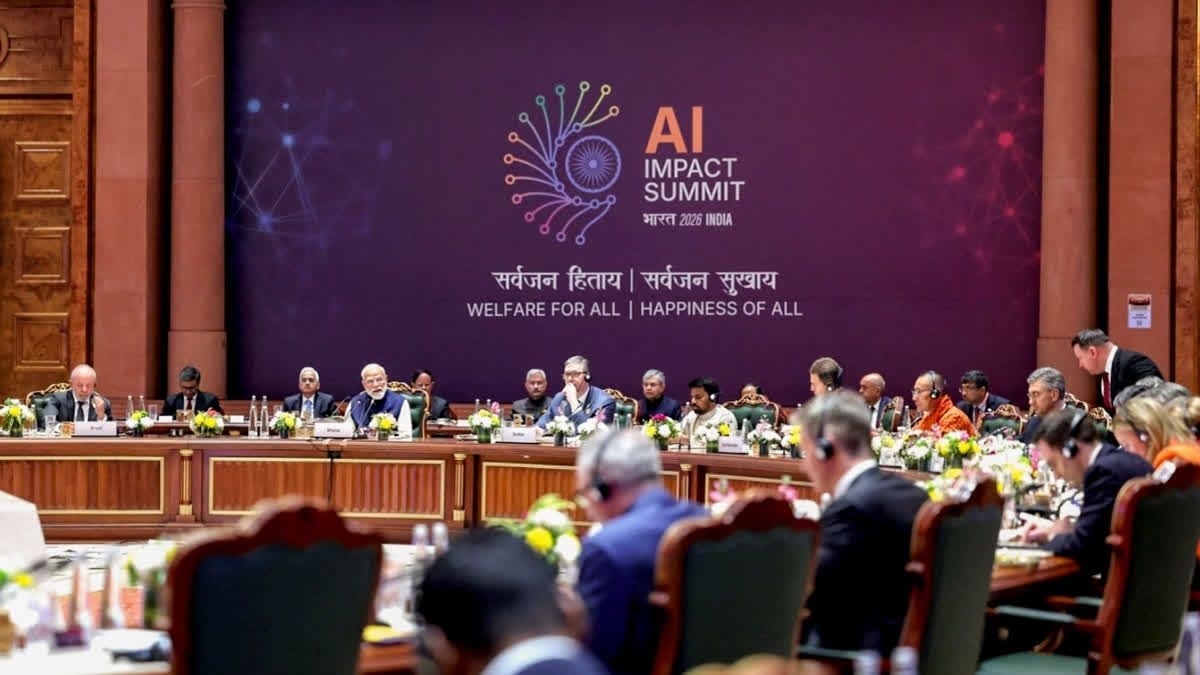
The US, UK, China, and France are among the 88 countries and international organisations that endorsed the ‘New Delhi Declaration on AI Impact’ on Saturday, marking the conclusion of the India AI Impact Summit.
On the principle of ‘Sarvajan Hitaya, Sarvajan Sukhaya’ — Welfare for all, Happiness for all — the declaration underscores that the benefits of AI must be equitably shared across humanity. It emphasizes strengthening international cooperation and multi-stakeholder engagement, respecting national sovereignty, advancing AI through accessible, and trustworthy frameworks.
The declaration is structured around seven key pillars, that represent the foundation of global AI cooperation. These are democratising AI resources, economic growth and social good, secure and trusted AI, AI for science, access for social empowerment, human capital development, and resilient, efficient and innovative AI systems.
At the core of the document is the idea of “democratising AI resources” — that AI must not deepen existing digital divides, and instead, focus on the the need for enhancing affordability and access to AI resources.
A key proposal emerging from the summit is the deployment for open source AI applications, while keeping in mind the principle of economic growth and social good. To have an open source model for the engagement of developers and stakeholders is a fundamental that was reflected in the key notes of global AI leaders, including Sundar Pichai, Sam Altman and Sarvam’s Pratyush Kumar.
“Open-source AI applications and other accessible AI approaches, where appropriate, and wide-scale diffusion of AI use cases can contribute to scalability, replicability, and adaptability of AI systems across sectors,” the declaration read.
The declaration includes creation of a Global AI Impact Commons, a platform aimed at sharing and scaling successful AI use cases across regions. This is expected to facilitate cross-border collaboration in sectors such as healthcare, agriculture, and climate, while also opening up opportunities for countries like India to export AI-led solutions rather than just technology services.
The declaration also places significant emphasis on trust and security. It calls for advancing secure, trustworthy and robust AI as foundational to building trust and maximising societal and economic benefits. A proposed Trusted AI Commons would act as a shared repository of tools, benchmarks, and best practices.
Speaking with reporters at another event, IT Minister Ashwini Vaishnaw on Saturday said: “Prime Minister Narendra Modi’s human-centric AI vision been accepted by the world. Not just economic growth, even social harmony has to be kept in mind. Safety and trust are at the centre, they have been brought among the main points,” adding that a secure, trustworthy and robust AI framework has been focused on.
To promote the use of AI in scientific research, the declaration emphasises on removing structural barriers and increasing availability of AI research infrastructure, leading to formation of an International Network of AI for Science Institutions.
Alongside governance, the document highlights the economic implications of AI adoption. It points to the technology’s potential to drive productivity, enable new business models, and support social development. At the same time, it acknowledges the rising infrastructure and energy demands associated with AI systems, calling for the development of efficient and sustainable solutions.
Human capital emerges as another key theme, with the declaration stressing the need for large-scale skilling and reskilling initiatives.
While the framework stops short of binding commitments, it signals the need for international cooperation on AI. As AI leaders, across the summit have cautioned on the safe use of AI given the speedy pace of implementation, the intent remains for AI to be deployed for welfare of all.
“Inspired by the principle of Welfare for all, Happiness of all, we believe that AI’s promise is best realised only when its benefits are shared by humanity,” said the declaration’s opening statement.
Rain interrupts Pakistan vs New Zealand match at R Premadasa Stadium in Colombo, leaving uncertainty about game taking place. Cut-off time for full 40-overs game was 8:10 pm local time, after which game could be washed out. For T20I game to have result, both teams must play five overs each. Cut-off time for 5-over game is 10:16 pm IST.