Yakima
Kennewick
Resize:
• Blueberry Bridal becomes the first business to open at Vista Field, a former airport site being transformed into a $500 million regional town center
• The Port of Kennewick’s 103-acre redevelopment project will feature nearly 300 residential units and mixed-use commercial spaces across eight phases over the next decade
• Construction resumed after minimal PFAS contamination was found in only one location and remediated through soil excavation
KENNEWICK, Wash. — A historic milestone was reached today as the first business opened at Vista Field, marking a significant step in transforming the former airport into a $500 million regional town center.
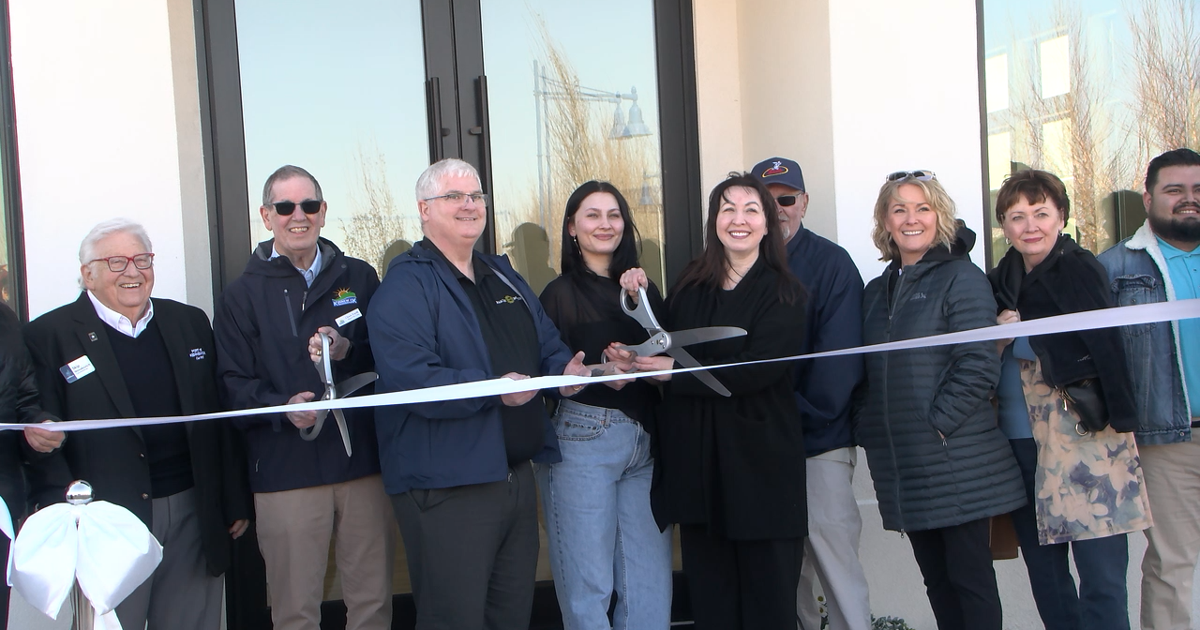
Blueberry Bridal, a wedding gown and formalwear boutique, celebrated its ribbon-cutting ceremony at the Port of Kennewick’s ambitious redevelopment project. The nearly 5,000-square-foot shop represents the first piece of a long-term vision to convert 103 acres of former airport land into a walkable urban community.
“It’s hugely significant, not just because it’s the first business, but because it is a small, single-lady entrepreneur,” said Tim Arntzen, CEO of the Port of Kennewick.
Vista Field served as a small airport in the middle of Kennewick until it closed in 2013. Since then, the Port has worked to develop the site into a mixed-use town center that will eventually feature nearly 300 residential units, including single-family homes, townhomes, row houses, and apartments, alongside commercial spaces for dining, retail, offices, and entertainment.
The redevelopment reflects community input rather than port priorities alone, according to Arntzen.
“I always tell everybody it’s the community’s master plan, not the port’s,” he said. “And the community wanted mixed-use residential. They wanted to see businesses like Blueberry Bridal.”
The project is structured in eight phases spanning the next decade, with development funded primarily through Port of Kennewick land sales, loans, and the Benton County Rural Capital Fund. Initial public infrastructure costs approximately $4.9 to $5 million.
Owner Amber Keller said she believed in the port’s vision for the area and saw an opportunity to be part of something transformative. She acknowledged the risk of opening before the rest of the project is completed, but said the potential made it worthwhile.
“I really believed in their vision for the area and the growth, and it’s really my vision as well,” Keller said. “So we kind of collaborated and came together, and I’m just really excited about how this is going to develop.”
Keller said she was drawn to the prospect of being part of a community centered around small businesses.
“I was really excited about being in a community where there will be a lot of small businesses,” she said. “Really, the small businesses are like the heart of the community. And so I was really excited to be a part of that.”
The Port reports that several parcels have already sold, with additional businesses and housing developments expected to follow. A Japanese restaurant, Kuki Izakaya, is scheduled to open next month as the second business at Vista Field. Future development includes a major $8 million, five-story mixed-use building featuring 4,000 to 7,000 square feet of retail and restaurant space with rooftop condos.
Port officials envision significant progress within five years.
“Within five years, you’re going to start to see a little bit of a small-town feel — here’s the town, here’s the epicenter of the larger 103-acre development,” Arntzen said.
The project faced a setback in June 2025 when construction was halted after PFAS chemicals were discovered during construction on private property. However, extensive testing by Landau Associates revealed the contamination was minimal and highly localized to a single spot.
Out of 47 samples tested, only one area showed elevated PFAS levels requiring remediation. The Port resolved the issue by excavating approximately 30 cubic yards of soil from that location for disposal at a licensed facility. Following the removal, the Port is seeking a “No Further Action” determination from the Washington Department of Ecology.
The high-density development will significantly impact local traffic and infrastructure. The project introduces a new network of smaller, interconnected streets designed for lower speeds to support walkability. Key intersection improvements include adding turn lanes at several major intersections, including Columbia Center Boulevard and Grandridge Avenue, and Colorado Street and Grandridge.
The development emphasizes pedestrian and cycling infrastructure, including sidewalks, pathways, and green spaces, though some main streets will mix cyclists with slow-moving traffic rather than provide dedicated bike lanes. Parking spaces are included throughout the development to meet commercial and residential demands.
BlueChart Homes is developing the residential component, focusing on modern urban design that appeals to a range of income levels. The site will also feature water features, public plazas, and pathways to encourage pedestrian traffic and community gathering.
Blueberry Bridal’s opening represents a symbolic transformation of the site from a place where aircraft once took off to one where new beginnings and community dreams can flourish. The redevelopment is projected to catalyze economic development throughout the Tri-Cities region.
COPYRIGHT 2026 BY APPLE VALLEY NEWS NOW. ALL RIGHTS RESERVED. THIS MATERIAL MAY NOT BE PUBLISHED, BROADCAST, REWRITTEN OR REDISTRIBUTED.
{{description}}
Email notifications are only sent once a day, and only if there are new matching items.
Your browser is out of date and potentially vulnerable to security risks.
We recommend switching to one of the following browsers: