This article first appeared in Wealth, The Edge Malaysia Weekly on March 23, 2026 – March 29, 2026
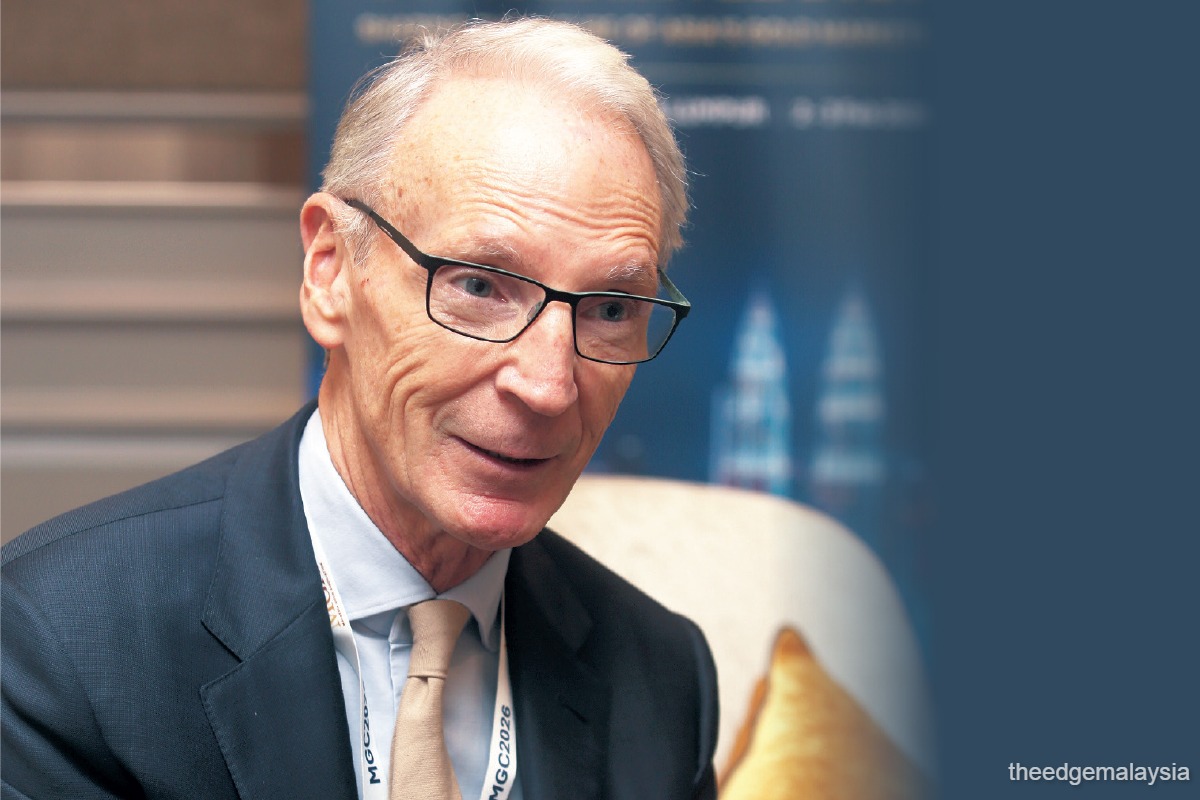
David Tait shut down Credit Suisse’s gold trading business when he was its global head of macro products group in 2014. Never did he think he would take the helm of the World Gold Council (WGC) as CEO five years later and become a proponent of gold as a strategic investment asset on the back of increasing global debt and currency debasement.
WGC, formed in 1987, is a membership organisation that champions gold as a strategic asset and aims to shape a responsible and accessible gold supply chain. Its 29 members have headquarters around the world and mining operations in over 45 countries, according to its official website.
In an interview with Wealth, Tait says he closed Credit Suisse’s gold trading desk as its return on capital was low compared with other asset classes, such as equities and foreign exchange. Traders cannot trade gold easily due to issues regarding transparency, custody and standards. All this makes it a rather complex and costly asset class to trade.
His outlook on gold today, however, is very different because of macroeconomic backdrop and the more secure and easier ways to trade the asset class. Despite a sharp correction of about 10% in a single day on Jan 30, Tait believes market demand for gold remains intact as government debts continue to increase globally.
Gold price rallied by about 67% in 2025, making it one of the year’s best performing asset classes. Tait analyses the key drivers of the high demand and points out trends that can send gold price higher this year.
Gold demand was at an all-time-high last year, underpinned by roughly 1,000 tonnes of gold purchases by central banks; 1,400 tonnes of gold bar and coin purchases mostly by retail investors; and 800 tonnes of purchases due to capital inflow into gold exchange-traded funds (ETFs), among others.
Geographically, China, Japan and India were key drivers of the gold price increase last year and will potentially continue to be so. With deregulation, the Chinese government allowed insurance companies to invest in gold for the first time, unlocking substantial liquidity into the gold market.
“They allowed 10 top insurance companies to invest 1% of their assets in gold as a test last year. They might be able to invest more if it is successful. Now, that alone is a US$5 trillion market. So, you can imagine if it goes up to 10% or 15%,” says Tait.
Japan, which has seen a deflationary environment for over two decades, was another contributor to last year’s gold price rally. Tait says the elderly in the ageing nation have been passing on wealth to the younger generation, many of whom are experiencing inflation for the first time in their lives.
He says inflation is expected to persist in Japan with the big win in the February snap election by Sanae Takaichi’s Liberal Democratic Party, clinching 316 of the 465 seats in the House of Representatives. Tait explains that it is the first time in 30 years that the country has elected a prime minister who plans to spend massive amounts of money despite an already high government debt level.
“Adding the fraught geopolitical situation into the equation, the Japanese yen seems set to be on a depreciating path [which will, in turn, contribute to inflation]. It is a very ripe market to invest in gold and gold ETFs (exchange traded funds). Again, that’s another US$5 trillion market starting from a very low base,” he says.
Then there is India, where a generation of young people who previously purchased jewellery can now invest much more easily in gold through ETFs. It is telling that 25 gold ETFs were launched in the country last year, says Tait.
The most crucial factors that make gold an attractive investment asset class are government debt and lack of trust in governments’ ability to rein in debt.
After US President Donald Trump announced sweeping tariffs on nearly all countries early last year, US Treasury yields spiked as investors became concerned about inflation and the funding of government budgets. The bond market caused Trump to pause the tariffs and temporarily lower the effective tariff rates on countries.
“At that point, the market didn’t fall because of economics. They fell because of a lack of trust in the system,” says Tait.
Therefore, gold has become a strategic asset that enhances portfolio returns, and not merely “insurance” or a hedge against a macroeconomic downturn.
“Gold today is a strategic asset. It’s no longer tactical. It should take up about 8% to 10% of your portfolio,” he says.
“Presidents come and go. Tariffs and policies come and go. One thing that doesn’t come and go is how a government manages money, the economy and debt. That doesn’t change over the short term.”
Gold price collapsed by 10% in a day in January when Kevin Warsh was nominated by Trump to lead the Fed Reserve after Jerome Powell’s contract ends in May. He is viewed by the market as having a relatively hawkish stance in terms of monetary policy and more likely to hike interest rates. Higher rates could translate into higher bond yields and a stronger US dollar, both negatives for gold prices.
But Tait does not expect such a scenario to play out even if Warsh were to take over from Powell. The opposite is, in fact, more likely. “Don’t think for a second that Warsh was given that job because he is not going to cut interest rates. He was given the job because he’s going to cut rates. He was just the guy the markets wanted the most to cut rates. So, I think the threat to the market, which is inflation on the back of runaway debt, is going to re-emerge.”
There is, however, one scenario that is putting downward pressure on gold price. Tait believes Trump and Treasury Secretary Scott Bessent are trying to force interest rates down to drive the US economic growth rate much higher, probably 6% to 7% gross domestic product growth with 3% to 4% inflation. Achieving this would let the US debt burden “inflate itself away”, but the probability of this happening is low.
“If Trump is able to pull that off, I think we might feel a little bit different about gold price. But right now, with the things that I’ve just mentioned, we are very positive for gold,” he says.
Tait shared these views with Wealth before the US and Israel launched large-scale coordinated strikes on Iran, which later shifted market expectations for US interest rates.
Tait started his career at Goldman Sachs in 1983 and held a senior trading role at UBS Investment Bank before joining Credit Suisse. Thus, he understands the pain points of gold traders.He says gold as an asset class was challenging for them to trade at scale due to issues surrounding transparency, custody, standards and even scams, resulting in relatively poor returns on capital compared with other asset classes. With digitalisation and the emergence of new investment instruments like gold ETFs, the situation has improved, but more can be done.
“Over the next few years, the most important thing for me is that the institutional world views gold as a strategic asset that is easy to trade and [from which] they can generate similar returns as other asset classes. That’s been my goal,” he says.
Tait, who also sits on the Bank of England’s (BoE) Financial Markets Standards Board, says the WGC has been working on behalf of the BoE to introduce reforms in the London gold market to further digitalise it.
He explains that the market currently operates through allocated gold and unallocated gold. Allocated gold means investors own specific physical gold in the form of coins, rounds and bars, while unallocated gold represents gold held in an account with a financial institution where a specific asset is not allocated to that buyer.
Tait is now pushing for a third model — the pooled gold interest market — that allows investors to have a claim on digitalised, fractionalised gold. “For the first time, an individual has a legal right to own digitalised fractions of gold, as opposed to only having such a right to big gold bars.”
What it implies is that with legal protection, a bank can now pledge a fraction of digitalised gold to another bank quickly and securely without involving the moving and storing of physical gold bars.
“You’ve always been able to pledge gold bars as collateral, yes. But for that to work, I’ve got to put them on a truck, drive them to your bank, and you’ve got to take them out at five o’clock every day [for audit]. Hence, many of this gold sits on the balance sheet without performing.
“By digitalising the physical gold that a bank has, they can now pledge it digitally and legally to the next bank without moving the physical gold bars. So, that’s one way in which gold will start to act as a currency within the institutional markets.
“For the first time, an individual will have the legal right to own digitalised fractions of gold as opposed to having such rights only to big gold bars. And we hope that the process will be extended to the average guy in the street in due course,” says Tait.
He adds that the WGC is now running the proof of concept (PoC) of the pooled gold interest market in London, which is expected to be completed by mid-year. The PoC involves major banks, including JPMorgan and HSBC, according to Tait.
Save by subscribing to us for your print and/or digital copy.
P/S: The Edge is also available on Apple’s App Store and Android’s Google Play.
Copyright © 1999-2026 The Edge Communications Sdn. Bhd. 199301012242 (266980-X). All rights reserved