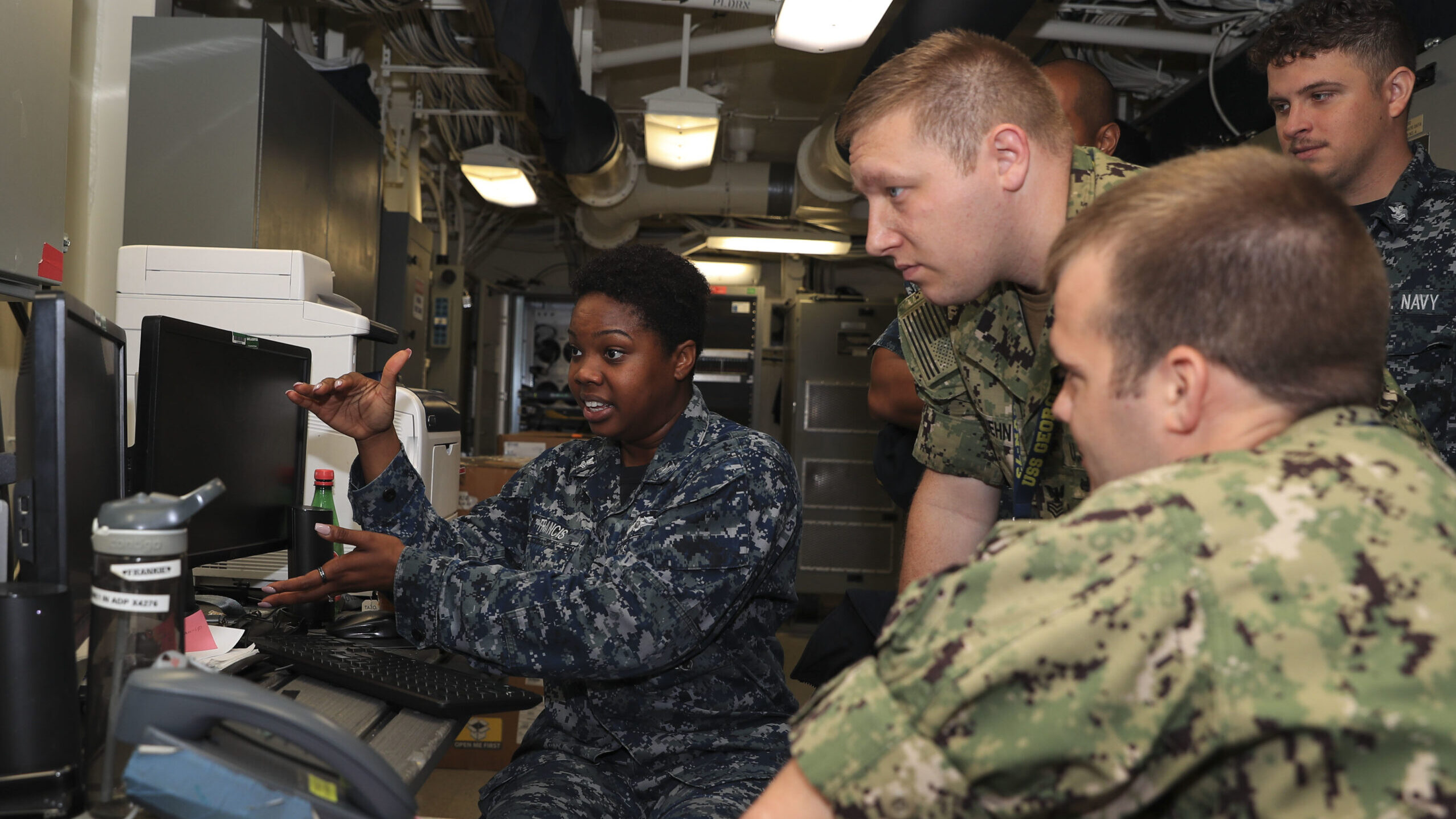
Leidos and Defense Unicorns will test prototypes in a lab-based environment under the other transaction agreement.
Share Options
Share a link to this article
WASHINGTON — The Navy has selected Leidos and software company Defense Unicorns to test software-only container prototypes under an other transaction agreement to provide updates to ships.
This is the first agreement under a new commercial solutions opening published earlier this year with the Naval Information Warfare Center Atlantic’s Rapid Capabilities Cell, established in October. (At the time it was called the Rapid Capabilities Office, but has since been rebranded the RCC, according to a Navy spokesperson).
“The Department of the Navy is modernizing its application infrastructure to accelerate the delivery of capabilities to the warfighter,” the spokesperson said. “We are seeking a container-native platform to serve as a standardized, enterprise-wide hosting solution. This will dramatically improve cyber resiliency through a zero-trust architecture and reduce the total cost of ownership of our systems. The goal is to deliver a software-only Minimum Viable Product that has been demonstrated, tested, and validated. This will ensure we can rapidly and securely deliver the applications our Sailors and Marines need to execute their mission.”
Delivering software updates to the networks aboard ships in the fleet is challenging, due in part to the fact these ships are deployed for long periods of time. Software updates require robust connectivity, typically only available when ships dock at their home pier. Even then, the updates require physically loading disks, which can be time consuming.
All told, the next software baseline for the Navy’s network upgrade can take about a year, Didier (DJ) LeGoff, Leidos senior vice president of Navy and Marine Corps IT, said in an interview.
“Today, the vast majority of the applications have to be loaded pier side with people actually walking on board with disks to load software. What this is doing is allowing us to be able to do that remotely,” he said of their solution.
Personnel will have visibility into the applications as well as the ability to upload, patch and distribute software all remotely, he added.
Government can’t stop to update systems, so modernization has to happen without interruptions.
The system they are testing as part of the prototype stems from work with airports, which face similar problems of working in limited or disconnected environments and require real time configuration management, he said.
It can be loaded onto any commercial stack and relies on packaging applications that can be sent over “less than robust links” in smaller chunks, LaGoff added.
The prototype will be tested in a lab-based environment in San Diego for a period of two months, LeGoff said, with the hope that there will be a follow on opportunity to take it to a shipboard test and eventually a production contract.
Defense Unicorns did not respond to a request regarding their offering by publication time.
Do more with less: streamline workflows, reduce duplication, invest upfront to save long-term.
Breaking Defense Europe will launch May 4 with Tim Martin and Elisabeth Gosselin-Malo as co-editors.
As threats rapidly evolve, digital engineering, manufacturing capacity and robust supply chains are critical to meeting challenges.
We will never sell or share your information without your consent. See our privacy policy.
© 2026 Breaking Media, Inc. All rights reserved. Registration or use of this site constitutes acceptance of our Terms of Service and Privacy Policy.