By Sonny Lo Shiu Hing
The recent annual duty visits of the Chief Executive of Hong Kong and that of Macau to Beijing are politically significant, partly because this practice has become an entrenched constitutional convention in the relations between the two Special Administrative Regions (SARs) and the central authorities in Beijing, and partly because of the important content of the discussions.
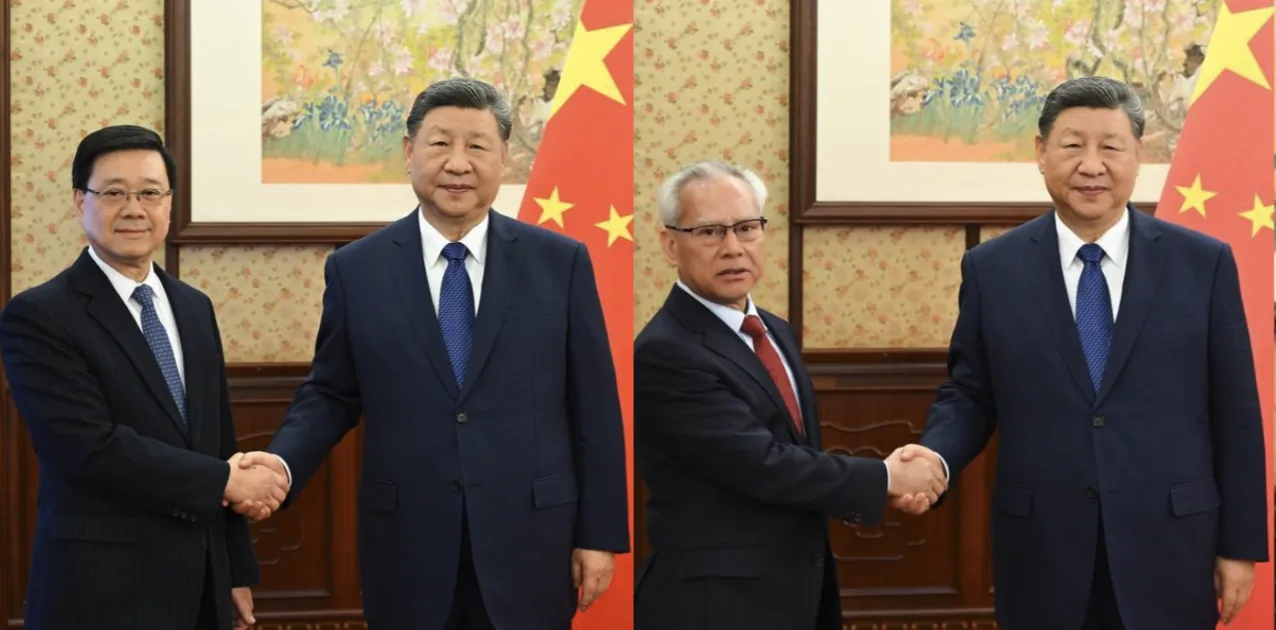
By convention, the duty visits of John Lee, the Chief Executive of the Hong Kong SAR, and Sam Ho Fai, the Chief Executive of the Macau SAR, demonstrate the “comprehensive jurisdiction” of the central government over the two special administrative regions. They also illustrate an important accountability mechanism in which the Chief Executive, the Director of the Hong Kong Macau Affairs Office, Xia Baolong, and the Director of the Liaison Office, who sat beside the Chief Executive of Hong Kong and of Macau as the two local leaders met President Xi Jinping separately, are constantly held accountable for their performance to the central leadership.
The sitting arrangements are politically noteworthy. With President Xi Jinping sitting in the middle of the long table, he presided over the reporting meeting. Sitting on his left-hand side were Premier Li Qiang, First Secretary of the Politburo Standing Committee Cai Qi, Vice Premier and Politburo Standing Committee member Ding Xuexiang, Head of the United Front Department Li Ganjie, and Secretary of the Political and Legal Commission Chen Wenqing.
Ding is also the leader of the Central Leading Small Group on Hong Kong and Macau. Institutionally speaking, the HKMAO Director is held accountable to Ding. While Li Qiang was sitting opposite John Lee (and opposite Sam Ho Fai in the separate meeting with the Macau side), Cai Qi was facing Xia Baolong, and Li Ganjie facing the Liaison Office Director (Zhou Ji in the Hong Kong case, and Zheng Xincong in the Macau case).
From President Xi’s emphasis on the alignment of Hong Kong and Macau’s developmental plan with the national economic blueprint, and from his stress on the deeper integration of the two SARs into the Greater Bay Area, it can be anticipated that, by 2047 and 2049 respectively, both Hong Kong and Macau will combine with the Greater Bay Area into a new socio-economic powerhouse
This arrangement showed that the central leadership attached immense importance to Hong Kong and Macau’s governance, which has been entrusted to the two Chief Executives, the Director of the Hong Kong Macau Affairs Office (HKMAO), and the Liaison Office Director. The fact that the Chief Executive, the HKMAO Director and the Liaison Office Director were all sitting on one side proved that they constituted a triangular governing and institutional structure that governs Hong Kong, and that this structure is directly accountable to the central-level leadership.
On December 16, when President Xi Jinping met John Lee, he affirmed the latter’s work. The President said that the central government is confident with the work of Lee and his government. Xi remarked that John Lee led Hong Kong with courage and determination, ensured the protection of national security and achieved the development of Hong Kong in the past year. The President offered his condolences to the victims of the “heart-breaking” fire incident at the Wang Fuk Court in Tai Po. President Xi also touched on the 15th Five-Year Plan, adding that the local government in Hong Kong should align its development with the central government’s developmental blueprint, thereby achieving stable economic growth.
In response to Xi’s remarks, John Lee thanked him and the central government for the care and support of Hong Kong. Lee said that he and his government promised to do the utmost for the follow-up action on the Tai Po fire tragedy. Lee stated that the Hong Kong government is pursuing outcome-based governance, further reforms, and expects to end its financial deficit this year. He referred to the rise in Hong Kong’s international rankings in various aspects, showing the confidence of the international community over the prospects of the SAR. Lee also touched on the success of the December 7th Legislative Council elections.
After Lee’s meeting with President Xi and the top Chinese political leaders, he revealed to the media that the President instructed the SAR government to ensure “full accountability” over the deadly Tai Po inferno by going into the details of the matter. Lee said he reported to the President the formation of an independent committee and the government’s work in supporting the victims (RTHK, December 16, 2025). Moreover, systemic reforms would be formulated and implemented to prevent the occurrence of another Tai Po-type incident. Lee said: “I have made it very clear to President Xi that the committee’s purpose is to find out the truth, and also to look for accountability” (RTHK, December 16, 2025).
A triangular structure composed of the two local governments led by the Chief Executives, the HKMAO and the Liaison Office is constantly held accountable to the top Chinese political leadership
Lee elaborated on the legislative elections by saying that the people generally supported the government’s post-disaster work and forward-looking approach after the Tai Po fire tragedy.
Lee also touched on the court’s guilty verdict against former media tycoon Jimmy Lai in the important national security trial. According to Lee, President Xi affirmed his recognition of the efforts of Hong Kong and its judiciary to “uphold the duty of safeguarding national security”.
In response to the President’s call for Hong Kong to align its development with the nation’s 15th Five-Year Plan, John Lee said that the SAR would proactively integrate into the motherland’s developmental blueprint.
President Xi’s December 2025 meeting with Macau Chief Executive Sam Ho Fai was the first one after Sam was elected in October 2024 and was later sworn in as the sixth-term Chief Executive on December 20, 2024.
As with the case of meeting John Lee, President Xi Jinping affirmed and praised the work of Macau Chief Executive Sam Ho Fai. The President remarked that Sam and his team demonstrated strong commitment to fulfilling their duties and to achieve concrete results by safeguarding national sovereignty, security and developmental interests. Moreover, Macau succeeded in conducting the eighth Legislative Assembly elections, advancing public administrative reform and accelerating the development of the Guangdong–Hong Kong–Macau Greater Bay Area (Xinhua, December 16, 2025).
Xi added that Macau should continue to align itself with the Chinese Mainland’s 15th Five-Year Plan, to uphold the executive-led system, to advance the SAR’s economic diversification programme, and to refine and deepen its integration into the motherland’s development blueprint.
Sam Ho Fai briefly talked about his government’s plan in 2026, including welfare measures, continuous public administrative reforms, Macau’s deeper integration into the Greater Bay Area, and the refinement of the national security legislation in the aspects of anti-terrorism and anti-money laundering work (Xinhua, December 16, 2025).
Regarding economic diversification – an issue mentioned by President Xi – Macau will have to do more for the sake of reducing the governmental revenue’s heavy dependence on the gaming industry
Judging from the content of the two meetings with the Chief Executives of Hong Kong and Macau, the central leadership in Beijing has demonstrated its full support of the principle of “one country, two systems”, its affirmation of the work of John Lee and Sam Ho Fai, its emphasis on the need to uphold the executive-led system through the protection of national security and the successful organisation of the legislative elections, and its aspiration that both Hong Kong and Macau must speed up the pace and broaden the scope of socio-economic and technological integration with the Greater Bay Area.
In particular, President Xi mentioned the need for both SARs to align their economic development with the 15th Five-Year Plan of the Chinese Mainland. Historically speaking, this was the first time a Chinese President explicitly mentioned the necessity of the alignment of Hong Kong and Macau’s developmental plan with the nation’s five-year developmental blueprint.
The occurrence of the fire incident in Hong Kong has added a new element of governance in John Lee’s meeting with the central leadership. John Lee’s emphases on post-disaster reconstruction and relief work, and on the issue of accountability, were important ones that explained why the independent committee will have nine months to come up with a concrete report – a report that will serve as the basis for the Chief Executive to report to Beijing by December 2026.
It is noteworthy that the deeper integration of both Hong Kong and Macau into the Greater Bay Area remains a policy priority of the central government’s policy towards the two SARs. As such, the Hong Kong government’s policy of developing the Northern Metropolis through the attraction of investment from the mainland’s scientific and technological enterprises, the construction of infrastructure projects, the migration of more Hong Kong people to reside in the northern district, the establishment of more transport connections between the northern district and Shenzhen, and the construction of various campuses for Hong Kong’s universities must be accelerated.
Comparatively speaking, Macau has achieved more rapid progress in its development of the Guangdong-Macau In-Depth Cooperation Zone in Hengqin because at least some Macau people have begun residing there while new developments are speeded up.
However, in the aspect of economic diversification – an issue mentioned by President Xi – Macau will have to do more for the sake of reducing the governmental revenue’s heavy dependence on the gaming industry. The central government’s stance on Macau’s economic diversification has remained quite constant, reflecting the centre’s perspective that Macau’s casino capitalism must be diluted to stimulate the development of other economic sectors, while maintaining the thrust of its social welfare to care for the elderly and the needy in Macau.
From President Xi’s emphasis on the alignment of Hong Kong and Macau’s developmental plan with the national economic blueprint, and from his stress on the deeper integration of the two SARs into the Greater Bay Area, it can be anticipated that, by 2047 and 2049 respectively, both Hong Kong and Macau will combine with the Greater Bay Area into a new socio-economic powerhouse.
Such a fully integrated southern economic powerhouse will be expected to achieve China’s long-term developmental objectives of (1) capitalising on the strengths of the two SARs to fully develop the southern coastal region further, and (2) of generating a special capitalist-socialist economic hybridity with the features of a high degree of productive forces, a strongly competitive edge, and a vibrant as well as dynamic economic locomotive driving the persistent modernisation and combined socialist-capitalist development of the inner regions of the Chinese Mainland. As such, Hong Kong and Macau must realise the huge potentials and significant economic utility in the eyes of the central leadership for the sake of assisting the continuous and permanent economic modernisation of the Chinese Mainland.
The recent duty visits of John Lee and Sam Ho Fai to President Xi Jinping and other top political leaders of the central government have deep repercussions for the political and economic development of the two SARs. Politically, the central government’s “comprehensive jurisdiction” over Hong Kong and Macau has already been institutionalised and entrenched.
A triangular structure composed of the two local governments led by the Chief Executives, the HKMAO and the Liaison Office is constantly held accountable to the top Chinese political leadership. Such accountability could be seen vividly in the case of how the Hong Kong government has to manage the post-disaster work of the Tai Po fire incident in an effective, accountable and swift manner. In the cases of both Hong Kong and Macau, the central leadership has expressed its clear intention of accelerating the integration of the two SARs into the Greater Bay Area and aligning their developmental planning with the 15th Five-Year Plan.
As such, Hong Kong and Macau, as two SARs, must learn from the virtue of long-term and strategic socio-economic planning of the central government amid the necessity of protecting national sovereignty, national security and developmental interests.
Nine people were killed when unknown gunmen opened fire at a bar outside Johannesburg early Sunday, police said, in the second such shooting in South Africa this month.
A young girl and Holocaust survivors were among 15 people shot and killed when gunmen opened fire on a Jewish Hanukkah festival gathering on Australia’s Bondi Beach a week ago.
Albanese said he has ordered a review into the federal police and intelligence services in light of the attack, to ensure they have the structure and powers “to keep Australians safe”.
A patient suffering from tetraplegia steered a smart wheelchair through the neighborhood with only his thoughts and directed a robotic dog to fetch a food delivery.
As global travel trends shift to accommodate diverse needs, accessible tourism and senior-friendly services have emerged as critical pillars of Macau’s tourism strategy.
UTM Comments is a partnership between Macau News Agency and Macao University of Tourism By Jeremy, Phillips Jeremy Douglas So much to scroll through, so little time. Phones and other ‘smart’ devices are time sucks and mental magnets. Constant connection comes with an attentional cost. A recent study from the American National Academy of Sciences investigated what happens […]
Since 2019, 200 university students from The Macao University of Tourism (UTM) have participated in a week-long volunteer teaching activity (VTAs) in rural Cong Jiang County, Guizhou province. These immersive programmes hold significant potential, beyond traditional classroom settings, for the development of professional skills and competencies, attitudes and personal qualities. Could corporate organisations also benefit?
UTM Comments is a partnership between Macau News Agency and Macao University of Tourism By Tammy Ku As Macau continues to evolve through urban redevelopment, land reclamation, and infrastructure expansion, a small but determined community in Pátio do Espinho is working to preserve something irreplaceable: the living culture of the “Pátio” village in line with Na […]
Leading business news and insights from Macau, covering gaming, finance, tourism, and economic developments.
© 2025 Macau Business. All rights reserved.