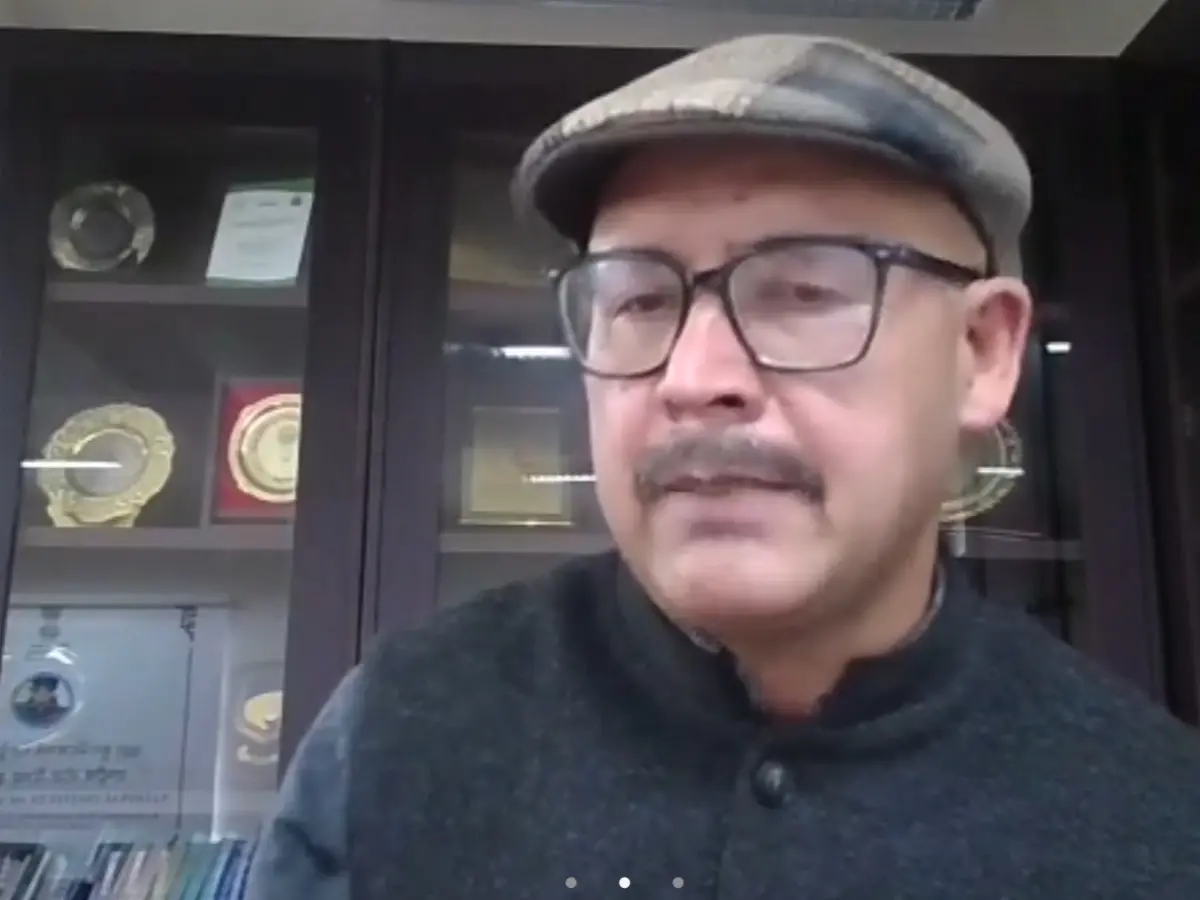
Padma Gurmet led the revival of Sowa-Rigpa in India, securing its AYUSH recognition and building institutions in Ladakh, transforming it into a modern, research-backed healthcare system with global ambitions.
In the 8th century, a healing tradition born in India -preached, according to its foundational text, by Lord Buddha himself at Bodh Gaya -crossed the Himalayas into Tibet. It flourished there for centuries, adapted, innovated, and grew into one of the world’s most sophisticated traditional medical systems. Back in mainland India, it faded into the shadows. In Ladakh, however, it never left. And today, one man more than any other is responsible for bringing it back -not as folklore, not as a cultural curiosity, but as a formally recognised, scientifically engaged, institutionally anchored medical system with colleges, research laboratories, public health deployments, and a seat at the table of India’s national health architecture. That man is Padma Shri Dr Padma Gurmet, Director of the National Institute of Sowa-Rigpa in Leh -and in an exclusive interview with WION, he has spoken for the first time in full about the 30-year battle that made it possible.
Also Read: ‘China claimed it, India will own it’: The battle for Sowa-Rigpa’s UNESCO status
Long before policy files and parliamentary committees, there was a father, a lantern, and a call in the night. “My father was a famous healer,” Dr Gurmet told WION. “From childhood I saw his practice, the way he dealt with patients, and the way he made medicine. During those days, modern medical facilities were quite weak in Ladakh. I remember he used to get calls at night from different villages, and he had to go to those places.”
What struck the young Gurmet was not the medicine itself, but the spirit behind it. “I saw his practice as service. He practiced with a pure heart. For him, it was not a business; it was more of a religious practice. Serving patients was the main motto of his life.”
Growing up, he helped grind herbs, collect medicinal plants from the mountains, and assist in the preparation of formulations. Yet, like many young men of his generation facing a modernising Ladakh with limited job prospects, he was not initially drawn to following in his father’s footsteps. “As a young school-going child, I was not very keen to pursue that kind of practice,” he admitted. What changed his mind was watching the tradition itself begin to disappear.
By the time Dr Gurmet completed his six-year degree in 1996–97, Sowa-Rigpa existed in a legal and institutional no-man’s land. It was practised, yes -he estimates that even before formal recognition, nearly 50 percent of Ladakh’s populationrelied on traditional Amchipractitioners. But it was unrecognised, unregulated, and increasingly unsustainable. The consequences were immediate and personal. After joining the Central Council for Research in Ayurvedic Sciences as a research officer in 1997, every attempt to expand the small Leh-based unit he worked in was blocked by the same institutional wall. “Whenever I moved a file requesting more manpower or more research infrastructure, the only answer was: your system is not formally recognised, so expansion is difficult.”
Then came the ultimatum. The unit was to be wound up and its staff relocated to a mainstream Ayurvedic institution in Jammu. “We faced great difficulty, but with resistance and the help of social and political leaders, we managed to save that unit,” Dr Gurmet recalled. “That day I decided that the ultimate goal was to formally enter the AYUSH system of medicine so that growth and further progress could be achieved.” It would take more than a decade.
What followed was one of the most methodical, persistent advocacy campaigns in the history of Indian traditional medicine -conducted not from the corridors of power in Delhi, but largely from Leh, at 11,000 feet. Dr Gurmet and his colleagues organised five to six major national conferences in Delhi, bringing together practitioners, policymakers, politicians, and ministers. They built parliamentary committees. They engaged Buddhist parliamentary forums. They produced evidence. And they kept encountering resistance -including from government committees that dismissed Sowa-Rigpa as merely a translation of Ayurveda. “Two or three committees made such negative reports in 2008,” Dr Gurmet said. “They did not go into detail.”
The turning point came when then-Health Minister Dr Ambani Ramdas visited Ladakh and saw the system firsthand. On returning to Delhi, he directed his secretary, Madam Anita Das, to constitute a dedicated committee for Sowa-Rigpa -separate from the broader traditional medicine review bodies. Dr Gurmet was made its convener. “There were members from diverse fields: allopathic medicine, Ayurveda, and Buddhist scholars,” he said. “We prepared a 350-page reportafter inspecting the entire Himalayan belt. That report became one of the key bases that went to the parliamentary committee.”
The result, when it finally came, was unambiguous. “With a full majority in both Houses, the bill passed without any objection, and we became a part of AYUSH.” The 2010 amendment to the Indian Medicine Central Council Actformally recognised Sowa-Rigpa as a full-fledged Indian medical system. But recognition on paper was only the beginning.
The distance between where Sowa-Rigpa stood in 1997 and where it stands today is, by any measure, remarkable. When Dr Gurmet entered the first formal batch of students at the Central Institute of Buddhist Studies in Ladakh, there were 15 students. Only five passed the final examination after six years. Today, six to seven colleges across the Himalayan region run Sowa-Rigpa programmes -and every seat in every college is filled. “Now, after recognition, the door has opened,” Dr Gurmet said. “Almost 70 people are now employed in the main health system in Ladakh, which is a big number considering our limited resources.”
Those 70 Amchis-traditional Sowa-Rigpa physicians -are now deployed at primary health centres across Ladakh, working alongside allopathic doctors in what Dr Gurmet describes as a “cafeteria approach” to healthcare. “You can choose whichever medical system suits you. That opportunity exists.” He is clear-eyed about where each system has its strengths. “There are many illnesses where allopathy has limitations. For example, arthritis and other lifestyle disorders can often only be controlled by allopathy. In many cases, traditional medicine manages them better, and there are no side effects.”
On cancer -a question the world increasingly asks of traditional systems -he is measured and honest. “We cannot say we can completely treat cancer, but we can manage it better, without side effects or complications. At least we can increase lifespan and improve quality of life.”
On 25th January 2026, Dr Gurmet received a call from the Ministry of Home Affairs. He had been empanelled -possibly shortlisted, nothing confirmed. He thought little of it and went about his day. Later that afternoon, an unknown Delhi number called while he was having lunch. He answered, expecting a ministry official. “He said, ‘Sir, congratulations, you have been selected for the Padma.’ I said, ‘No, I don’t know. Thank you so much.’ Then he asked what I thought about it. I said I would call him back later, but he said I was on live TV.” In that unscripted, unrehearsed moment, Dr Gurmet said what he truly felt. “I told him that this is not only respect for me, but recognition for the entire system of medicine. This award was not just for me, but for the entire community and our cultural heritage, for everyone who has practised this system for such a long time.” And then, in that same moment, a face came to mind. “I was remembering my father, who had passed away five or six years earlier. His face was in front of me. He was one of the most famous Amchisof Ladakh. Amchi Tashi was his name, and he was the one who put me into this system.”
His father had defied the sceptics. “When he put me into practice, many of our relatives told him, ‘Why are you spoiling your child’s life? This is a profession with no scope.’” Amchi Tashi, it turns out, had better vision than the sceptics.
The Padma Shri, Dr Gurmet is quick to point out, is not a conclusion. It is a deadline. At NISR-Leh, the next ambition is to achieve deemed university status -giving the institute the autonomy to design its own curriculum and set its own research agenda. The Trans-Himalayan herbal garden he established over 15 years now holds more than 100 medicinal plant species, cultivated at 11,000 feet and studied for their phytochemical profiles under changing climate conditions. A second garden at higher altitude is already in planning. On the economic frontier, the gap remains stark. India’s Sowa-Rigpa industry is currently valued at approximately 11 million US dollars. China’s Tibetan medicine industry generates billions of dollars annually. The recent inclusion of Sowa-Rigpa formulations under India’s Drugs and Cosmetics Act -just six months ago -has, for the first time, opened the door to licensed commercial production. Internationally, Dr Gurmet is in active dialogue with WHO’s Global Traditional Medicine Centre in Jamnagar, and has opened collaborative channels with Bhutan, Nepal, and Mongolia -all nations where Sowa-Rigpa is practised and where a shared research and conservation framework could be built.
India’s UNESCO nomination for Sowa-Rigpa as Intangible Cultural Heritage -filed in 2019, with Dr Gurmet leading the dossier preparation -remains under consideration, with amendments being prepared for resubmission. “Our ambition is to make the National Institute at least a deemed university,” he said. “The second focus must be research. It is an ambitious project.” At 11,000 feet in Ladakh, where plants that once flowered in August at higher elevations now bloom in April under Dr Gurmet’s cultivation programme, an ancient medicine is learning to adapt. So, under his watch, is the system that carries it.
Naresh Chander tracks developments from conflict zones to trade corridors, bringing clarity to complex global developments with ground-level insights and hard substance over clicks…Read More