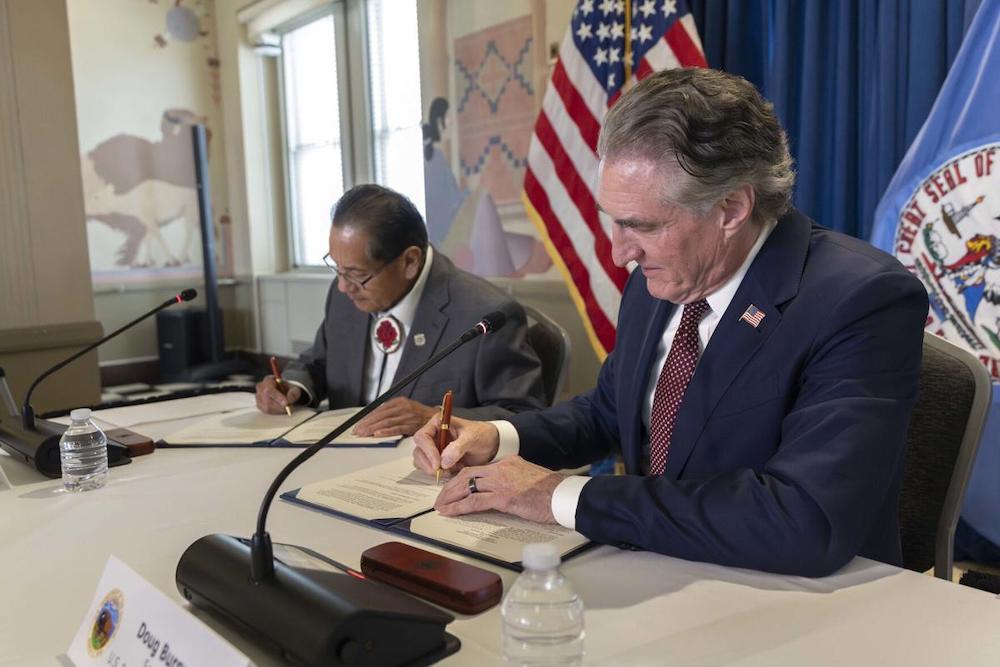
The Southern Ute Indian Tribe became the first tribe in U.S. history to secure federal approval of a Tribal Energy Resource Agreement on Monday, expanding tribal control over energy development on its trust lands.
The agreement follows years of criticism from tribes, Congress and federal oversight agencies that lengthy federal review processes slowed energy development and created uncertainty for projects on tribal lands.
Congress authorized TERAs in 2005 to give qualified tribes greater authority over energy development decisions and reduce reliance on federal approvals for certain leases, agreement and rights-of-way on tribal lands.
The signing took place in Washington, D.C., where tribal Chairman Melvin J. Baker, Vice Chairman Marvin Pinnecoose, members of the tribal council, legal representatives and Growth Fund leadership joined Secretary of the Interior Doug Burgum and Assistant Secretary for Indian Affairs Billy Kirkland III.
The agreement applies to energy and mineral resources within reservation boundaries held in trust for the tribe.
Tribal lands contain substantial energy resources, including an estimated 20% of known U.S. oil and gas reserves, according to a 2017 Department of Energy assessment cited by the Congressional Research Service.
Under a TERA, tribes can enter into certain energy leases and rights-of-way without additional Secretarial approval after the initial agreement is approved by the Interior Department.
Although several tribes have explored TERAs since Congress authorized them in 2005, the Congressional Research Service noted earlier this year that no tribe had previously completed the process.
“This agreement reflects decades of strategic institution‑building, responsible energy development and environmental stewardship,” said Melvin J. Baker, chairman of the Southern Ute Indian Tribe. “TERA formalizes what the tribe has proven for generations — that we have the expertise and the governance systems to manage our resources responsibly while advancing the well‑being of our tribal members and safeguarding our land, water and culture.”
The tribe’s energy governance dates to the tribe’s 1949 mineral leasing program and expanded significantly with the creation of the Energy Resource Division in 1980, now the Department of Energy under the Growth Fund.
The department oversees severance tax collection, royalty auditing, environmental review and compliance across thousands of energy‑related facilities, and has conducted roughly 3,000 inspections since 2017.
The tribe has adopted a tribal leasing code and a tribal environmental review policy code to support the agreement. Both require environmental and cultural review, incorporate tribal member input and align project approvals with community priorities.
Congress and federal oversight agencies have repeatedly criticized the Bureau of Indian Affairs for delays and uncertainty in tribal energy approvals. A 2015 Government Accountability Office report found that BIA mismanagement and lengthy review processes hindered development opportunities on tribal lands.
Interior Secretary Doug Burgum said the tribe’s expertise set a “strong example for Indian Country,” pointing to “decades” of building the government structures needed for a TERA.
House Natural Resources Committee Chairman Bruce Westerman, R-Ark., said in a statement that the agreement could expand tribal economic opportunities and energy development on tribal lands.
Growth Fund leadership said the agreement provides clarity and stability for long‑term planning.
“Process certainty is essential,” said Kourtney Hadrick, operating director for the Southern Ute Growth Fund. “A clear, transparent and predictable framework is critical for tribes evaluating whether a TERA is feasible, particularly given the significant investment of staff time and resources required. A TERA places decisions with tribes, allowing them to act in the best interests of their people without being subject to shifting federal priorities.”
The agreements can apply to both renewable and nonrenewable energy projects, including oil, natural gas, coal, uranium, wind, solar, geothermal and biomass projects.
Policy experts said the agreement strengthens self‑governance while highlighting the limits of federal Indian law.
Crystal Miller, policy director at the nonprofit Alliance for Tribal Clean Energy, called the agreement “a meaningful and hard-earned advancement in tribal self‑governance” because it reduces layers of federal oversight.
But Miller said tribal authority under a TERA still operates within a federally delegated framework rather than full tribal sovereignty.
“This is an important step toward greater self‑determination,” she said, “while also illustrating the broader work that still remains to fully realize inherent tribal sovereignty beyond federal permission-based systems,” she said.
Cheri Smith, CEO of the Alliance, said the agreement could serve as a model for other tribes, though few currently have the technical, legal and administrative capacity required to pursue a TERA.
“It’s a landmark occasion,” Smith said. “But we’re not sure when the next tribe is going to be ready to sign one of these.”
Brian Edwards contributed reporting.
This article is available to paid digital subscribers. Click here to sign in or get access.