CHESTERFIELD, Va. (WWBT) – Chesterfield County’s Board of Supervisors deferred a vote to put data center revenue toward lowering the county’s car tax rate Wednesday night, arguing they need more time to discuss.
But county staff used the meeting to answer questions from residents as debate over the developments continues.
“This is not the end of this discussion,” said Jesse Smith, deputy county administrator. ”This is the beginning of the conversation. We want to make sure that folks are getting the answers that they need.”
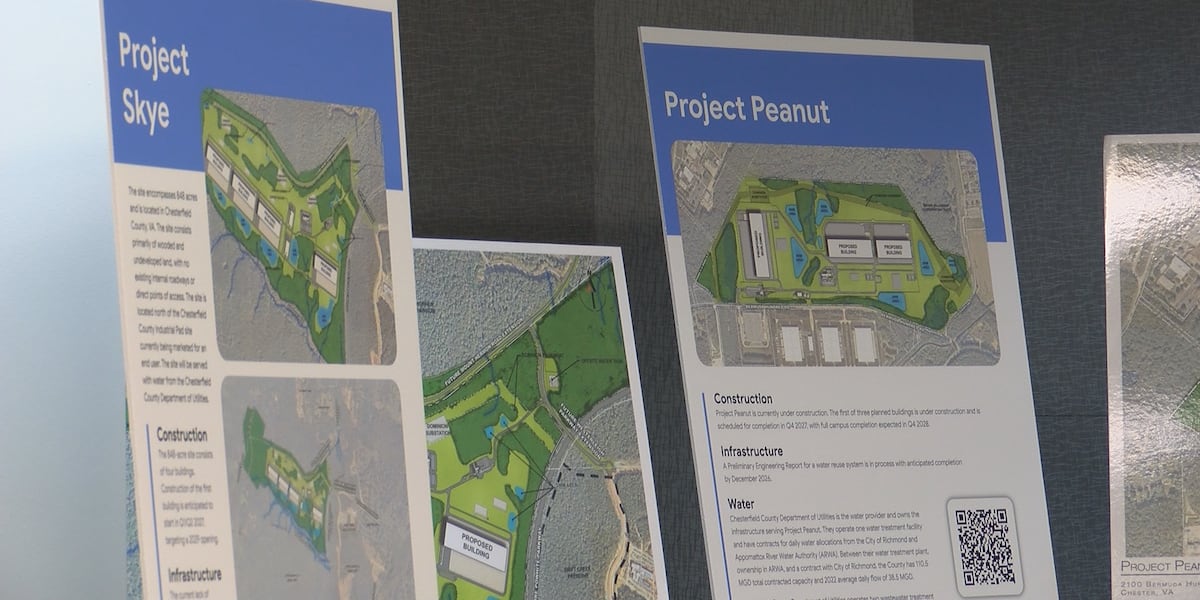
Deputy county administrators presented an update on three Google data center campuses currently planned in the county. County finance leaders said the campuses, once completed, could represent about $2.7 billion in real estate value, which they said would exceed the assessed real estate value of the county’s current top 10 principal taxpayers combined.
County officials said the county’s tax base is currently about 79% residential and 21% commercial. They said the Google buildout alone is projected to shift that to about 76% residential and 24% commercial, an estimated 18% increase in the existing commercial tax base.
Matt Harris, deputy county administrator, said the projects could help rebalance the tax burden between residential and commercial property owners.
“They really do hold a tremendous potential in terms of revenue generation to find that balance between residential and commercial taxpayers,” Harris said.
County estimates put revenue at roughly $8 million annually per campus from real estate alone, and more than $10 million when the equipment component is included, on the conservative end, according to county officials.
Harris said the three Google campuses, at full buildout, could reduce the county’s car tax rate by nearly $1 per $100 of assessed value under the county’s model. The current rate is $3.25 per $100. County officials said the reduction is a projection dependent on development occurring and is not an immediate tax cut.
Officials said full buildout of the campuses could take the better part of a decade, but said buildings would begin generating tax revenue as they are completed and assessed, rather than the county waiting for the full timeline to elapse.
Under a zoning change approved last year, any new data center would need a conditional use permit, requiring it to come before the Board of Supervisors.
“The board has also come out publicly and said they are not supporting any additional data centers. This is sort of what you see is what you get. This is the universe of data centers moving forward. So this is what we have,” a county official said.
Residents at the meeting raised concerns about water use, electricity demand and neighborhood impacts. The county said the Peanut site has access to as much as 6 million gallons of water a day under an existing agreement, and that its utility system can accommodate the projected volume.
Mary Finley-Brook, with Data Center Defiance, said questions about resource use remain unanswered.
“To date it has not been the fundamental questions we are asking.” Finley-Brook said. ”How much water, how much energy, where does it come from?”
County leaders deferred questions about energy demand to Dominion and questions about air quality to state regulators. Officials said they could bring those agencies in to answer further questions.
County economic development staff defended the use of nondisclosure agreements during the recruitment process, saying the agreements are commonly used with companies considering investments because businesses disclose information such as financial details, plans and facility layouts. Staff cited Lego and DuPont as other examples of economic development projects involving confidential information.
County officials said they received 172 community questions and concerns ahead of the meeting and are working on individual responses, with a goal of posting them within about a week.
Copyright 2026 WWBT. All rights reserved.