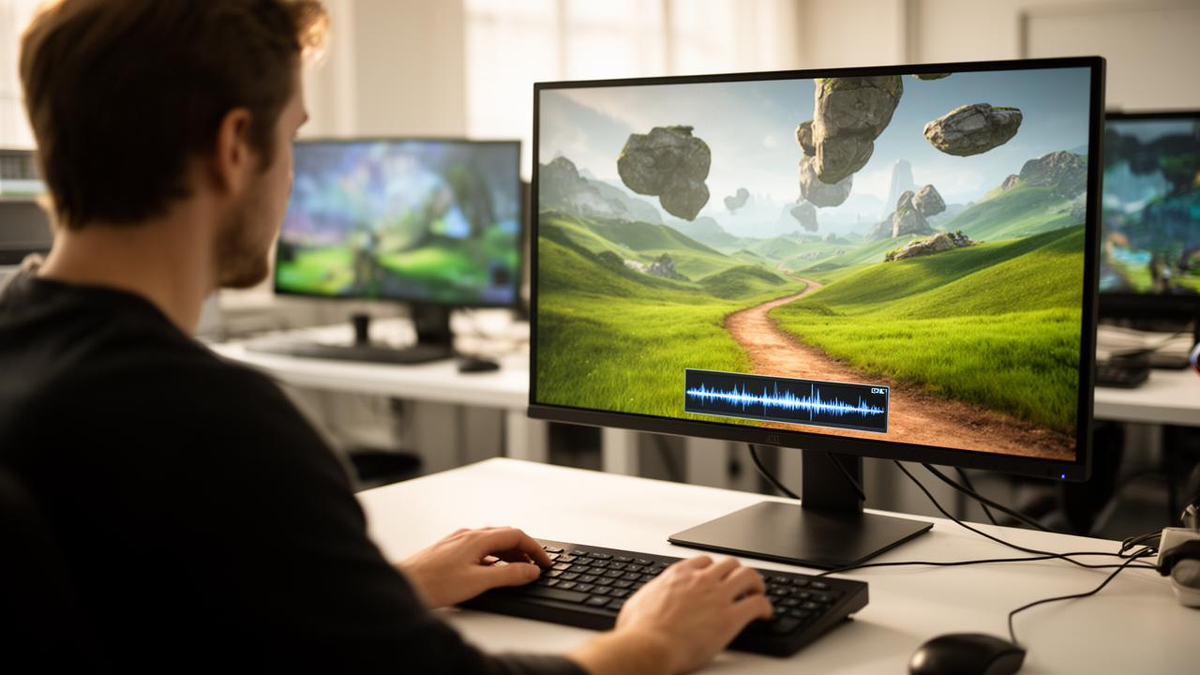
Google unveiled Genie 4 on Tuesday, the latest version of its world simulation model, which for the first time generates synchronized audio alongside interactive video and holds a coherent scene for roughly two minutes, twice the limit of its predecessor.
The model, built by Google DeepMind, is being released as a research preview to a small group of vetted testers, with access set to widen in the coming weeks to subscribers of the company’s top-tier Google AI Ultra plan through Project Genie, and to early-access partners using the Gemini API and Google AI Studio. Pricing for developer access has not been disclosed. The Ultra plan starts at $100 a month.
Unlike conventional video generators that turn a prompt into a fixed clip, Genie 4 builds an explorable environment and keeps rendering it frame by frame as the user moves through it. Users can type instructions mid-simulation to change the weather, shift the camera angle, or drop in new characters and objects, and the system adjusts the running scene rather than starting over.
Google describes the model as its most realistic and responsive world model to date. It said the physics engine handles aerodynamics and collisions more convincingly, and that simulated people move and react to their surroundings with less of the stiffness associated with earlier AI video.
Audio arrives, with Gemini as director
The headline addition is native sound. Genie 4 produces ambient noise, music and spoken dialogue that responds to events inside the simulation, rather than looping pre-recorded clips. Google said it is the first of its world models to generate audio natively.
Behind the scenes, a lighter-weight Gemini model acts as a planner. Gemini 3.8 Flash interprets the user’s goal, breaks it into steps, watches each rendered frame and steers the simulation to keep it on track. Google is also experimenting with its flagship Gemini 4 Argon in a research project tied to Gemini Robotics, in which the larger model decomposes a task into stages that Genie 4 then simulates in real time, a possible route to rehearsing robot behavior in virtual settings before trying it in the physical world.
“What we’ll increasingly see in the future are these hybrid world models, where you have a combination of Gemini writing code and text, and Genie ingesting that in real time and simulating reality at different levels of abstraction,” Tejas Kulkarni, a research director at Google, said during a briefing.
Diego Rivas, a Google DeepMind engineer, said the real-time nature of the system matters most where creative momentum is at stake, such as the ideation and storyboarding phases of a project. He cautioned that the product experience is still being defined and that capabilities such as turning prototypes into finished assets with Gemini Omni remain some distance away.
Limits remain, and so does the gaming question
Google acknowledged that the model is far from a finished tool. Visual detail can drift as a session wears on, and the team has not solved complex physical interactions, accurate audio or legible in-world text. A two-minute ceiling on consistency also means the environment will not hold every detail indefinitely.
Note: Comparison based on Google’s descriptions of the two models.
The launch lands in a world-model market that is consolidating quickly. Runway released its second playable world model earlier this year, and deal activity has picked up: Advanced Micro Devices is acquiring Fei-Fei Li’s World Labs, Amazon has held talks to buy Decart, and Rivian has bought Third Dimension to bring driving simulation in-house.
For game developers, the arrival of Genie 4 revives a question that rattled the sector in January, when the Project Genie prototype, powered by Genie 3, triggered a selloff in engine and tooling stocks such as Unity (U) on fears that text-to-world generation could automate scene construction and prototyping. The new model’s tighter real-time control and native audio give that argument more technical weight, though the gap between a generated environment and a shippable game remains wide. Commercial titles depend on stable rule systems, repeatable mechanics, precise character control and content that studios can maintain and revise over years.
Google’s own framing is incremental. Rivas said the aim is to expand what existing creative workflows can do, not to declare that production pipelines have been replaced. The company is working with selected partners in film and television, game design, education and robotics simulation to map where the technology fits and where its limits lie. Testers are trying pre-visualization for visual effects, reconstructions of historical scenes from verified archival material, and rapid prototyping of game environments.
Every video and audio output carries a SynthID digital watermark, Google said, part of an effort to distinguish AI-generated media from authentic recordings as the models move from producing static clips to running responsive virtual spaces.
For investors, the release is less a revenue event than a marker in the race to build simulation engines that could eventually serve robotics training, media production and interactive entertainment. DeepMind positions world models as a research path toward artificial general intelligence, on the theory that an AI which can predict how an environment responds to actions can learn from those predictions. Whether that translates into a durable commercial franchise depends on how quickly Google closes the consistency, physics and audio gaps, and on how readily developers adopt a tool that, for now, remains experimental.
The news and data on this website are for reference only and do not constitute investment advice or an offer to buy or sell. Information is sourced from exchanges and public sources, and may be delayed, interrupted, or updated. While we strive for accuracy, we do not guarantee timeliness, correctness, or completeness. Content may include external links for which we are not responsible. By using this site, you agree that we and our partners are not liable for any losses. Investment carries full responsibility; please carefully assess risks and consult professionals. If there are errors in the content, please contact us for correction.