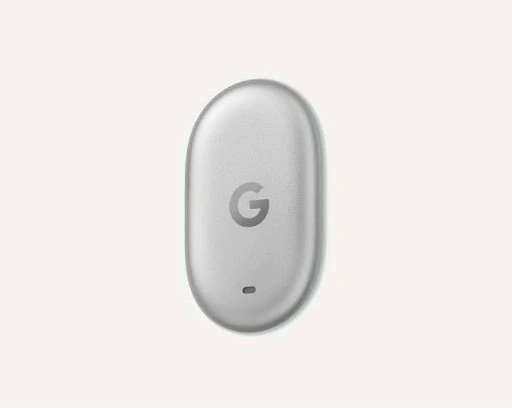
Google’s long-awaited answer to Apple’s AirTag is finally on sale. The Pixel Tag, a Bluetooth and ultra-wideband item tracker that works with the company’s Find Hub network, became available for purchase on Tuesday, roughly three months after it was first announced in August.
Pricing mirrors Apple’s AirTag 2: a single tracker lists at $29.99, while a four-pack is offered at $99.99. The device arrives after years in which Android users relied on third-party trackers from Samsung, Motorola, and Pebblebee to fill the same role.
Google has taken a noticeably different approach to hardware design. Rather than a round puck, the Pixel Tag is a slim oval measuring 1.1 inches wide, 1.8 inches tall, and 0.2 inches thick, compared with the AirTag’s 1.26-inch width and 0.31-inch depth. At 0.4 ounces with the battery installed, it is marginally lighter than Apple’s tracker. The trade-off is that there is no built-in hole for threading onto a keyring, so buyers will need a separate case or accessory to attach it to luggage, keys, or a bag.
Inside, the tracker uses a user-replaceable CR2032 coin cell, which Google says should last more than a year. It carries an IP67 rating, meaning it is dustproof and can withstand submersion in up to a meter of water for 30 minutes. A built-in speaker can play a chime at one of three volume levels set in the Find Hub app, with the loudest reaching about 80 decibels. A physical button on the tag can be pressed twice to ring a misplaced phone, a feature Apple’s tracker does not offer.
On the locating side, the Pixel Tag supports ultra-wideband and Bluetooth 6.0 Channel Sounding. Android handsets equipped with a UWB chip can show both the distance and direction to the tag in Find Hub once the user is nearby, while Channel Sounding provides distance alone. The device pairs with phones running Android 9 or later through Fast Pair, though the precision-finding features require hardware that specifically supports UWB or Bluetooth 6.0.
For items left farther afield, the Pixel Tag leans on Google’s crowdsourced network of more than a billion Android devices, which can detect and relay a lost tag’s position back to its owner as a pin on a map. The company has not included NFC, which Apple uses so that a finder can tap the AirTag and pull up the owner’s contact details. Instead, a tag placed in Lost mode can broadcast the owner’s email address, phone number, and a short message, and the item is automatically marked as found once it re-enters range of the owner’s phone. Location sharing is supported for up to 10 people through Find Hub, a feature aimed at shared belongings such as family car keys.
The tracker comes in silver and a pale green finish. Alongside the launch, accessory maker Bellroy is releasing its own keychain cases in a range of colors and styles, to be sold through the Google Store.
Note: AirTag 2 figures reflect dimensions and pricing disclosed by Apple; dashes indicate details not specified in the source material.
The launch puts Google directly into a hardware category Apple has dominated since the original AirTag debuted, and it gives the Android ecosystem a first-party option that ties into Find Hub, the renamed tracking service. For Android handset makers and accessory vendors, the arrival of a Google-branded tag could accelerate demand for UWB-capable phones and for cases and mounts built around the new form factor. It also sharpens competition in the crowdsourced tracking market, where network size matters as much as the hardware itself, and Google is betting that its installed base of Android devices can match Apple’s reach.
The news and data on this website are for reference only and do not constitute investment advice or an offer to buy or sell. Information is sourced from exchanges and public sources, and may be delayed, interrupted, or updated. While we strive for accuracy, we do not guarantee timeliness, correctness, or completeness. Content may include external links for which we are not responsible. By using this site, you agree that we and our partners are not liable for any losses. Investment carries full responsibility; please carefully assess risks and consult professionals. If there are errors in the content, please contact us for correction.