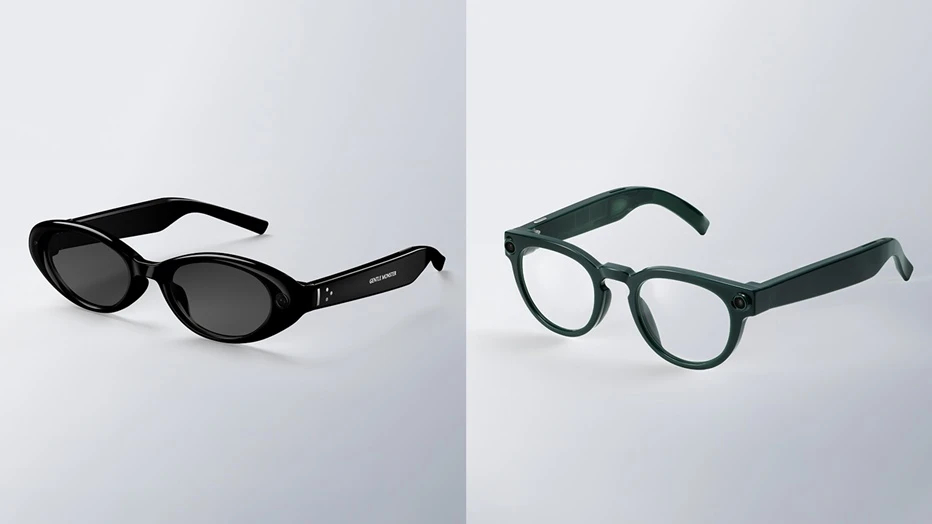
In the afternoon of November 10, China’s A-share AI glasses concept sector suddenly surged on heavy volume. Yingtong Communication and Zhaoyang Technology shot straight to their daily limit, while Siya Technology and Fullhan Microelectronics both recorded 20% limit-up moves, followed by names such as SigmaStar Technology, Allwinner Technology and Rockchip. The concept sector as a whole rose more than 4.5% that day, becoming the most conspicuous magnet for capital in an otherwise weak market.
The direct spark for the rally came from overseas. On November 9, Samsung Electronics and Google officially unveiled “Intelligent Eyewear,” their first jointly developed AI glasses, set to open for preorders on November 12 and launch officially in December. The device runs on Google’s generative AI model Gemini, with frames designed in collaboration with Gentle Monster and Warby Parker, and South Korea and the United States as the first launch markets.
To most market participants, this is not simply a product teaser but a signal that the competitive landscape in AI glasses could be loosening. According to Omdia, Meta held 85.2% of the global AI smart glasses market by shipments in 2025 and still commanded an overwhelming 81.3% in the first half of 2026. Counterpoint’s figures are even more aggressive: global smart glasses shipments grew 263% year-on-year in the first half of 2026, with display-free products accounting for 96%, and Meta alone swallowing 94% of the display-free AI glasses segment.
The Samsung-Google pairing is the first competitor in this segment whose model capabilities, hardware manufacturing and channel resources are all on par with Meta’s. When a monopoly of more than 80% faces a heavyweight rival, it is hard for capital not to react.
Demand-side signals are corroborating the story. China’s Ministry of Commerce big-data platform disclosed that smart glasses sales on key platforms grew 1.1-fold year-on-year in the first three quarters, while Omdia put first-half shipments at 4.2 million units, up 127% year-on-year. Smart glasses have officially entered China’s national subsidy catalog this year, folded into the home-appliance trade-in subsidy program—meaning policymakers already regard the category as a consumer device with mass-adoption potential.
The deeper narrative is the battle over the entry point. As OpenAI, Meta and Anthropic roll out personal agents one after another, the hardware that carries those agents is seen as the most important traffic gateway of the next generation, though its form factor remains undecided. Phones must be pulled out of a pocket; earbuds and watches are capped at voice and touch interaction. Only glasses sit on the organ humans use most naturally to take in information, giving them a native first-person perspective. Apple, Meta, ByteDance and OpenAI are all advancing AI glasses and AI-native devices: ByteDance’s Doubao AI glasses have been contracted for mass production at Longcheer Technology’s Nanchang plant with an initial order of 1 million units; Meta has doubled its 2026 AI glasses capacity target to 20 million units; and Apple has placed AI glasses on its hardware roadmap for the 2027 new-product innovation cycle. Ant Group’s “Lingying AOS,” released in September, is positioned precisely as an agent-native operating system for new terminals such as AI glasses.
Profit distribution along the supply chain is therefore highly concentrated. In AI glasses with display functionality, optical waveguides and optical engine modules together account for about 50% of BOM cost, with the AI main-control SoC at 25%—more than 70% combined. Even in structurally simpler display-free products, chips account for more than a third of cost. Whoever makes optics thinner and brighter, and chips smaller and more power-efficient, holds the valve on the profit pool.
The positioning battle on the optics side has reached the process-technology level. Goertek Optics in June 2026 commissioned China’s first 12-inch wafer DUV lithography and etching mass-production line, pushing micro-nano optical device production from the industry’s mainstream 4-inch and 6-inch formats straight to semiconductor-grade processes. On the chip side, Chinese import substitution is accelerating in tandem; rising localization rates for optics and chips are pushing down BOM costs, and lower costs in turn stimulate shipments—the gears of a virtuous cycle have begun to turn.
Concentration in midstream contract manufacturing is higher than outsiders imagine. Goertek has already captured the majority of AI glasses finished-product contract manufacturing: it exclusively assembles Meta’s Ray-Ban series, and also holds about 70% of Huawei’s AR glasses assembly and about 70% of Xiaomi’s first AI glasses. The need for prescription-lens adaptation has pulled traditional optics players into the chain—Conant Optical brought in Goertek as a strategic shareholder with a 20% stake, while Doctorglasses and RayNeo formed a joint venture. On the earnings front, Mingyue Optical Lens posted 33% net-profit growth in its 2026 third-quarter report and Doctorglasses 43.6%; value realization in lenses and optometry channels may come faster than in finished-product brands.
Note: The above data come from Omdia, Counterpoint and public disclosures, and statistical methodologies differ.
The cold reality is just as stark. Global AI glasses shipments of 8.46 million units in 2025 are not even a rounding error against smartphone shipments of well over a billion units a year. Most terminal brands currently lose money on nearly every unit sold; gross margins on display-equipped AI glasses are barely above 20%, and brands must still split revenue with distributors. The industry-wide return rate remained at 60-70% in 2026, versus the 15-30% typical of traditional online eyewear retail. The impossible triangle of performance, weight and battery life persists: every gram shaved off costs tens of millions of yuan, optimization precision has advanced to 0.1-gram increments, and marginal costs will only climb.
Yet heat in the primary market is accelerating. In the first half of 2026, there were at least 64 financing, M&A and strategic investment deals across the global smart glasses supply chain, with disclosed totals of about 9 billion yuan (approximately $1.3 billion), versus roughly 36 deals totaling about 4.367 billion yuan (approximately $654.9 million) in all of 2025. Bit Fantasy’s valuation jumped from 130 million yuan (approximately $19.5 million) to 1.5 billion yuan (approximately $224.9 million) after completing its angel round; INMO raised nearly 1 billion yuan (approximately $150 million) in a C+ round; Yiwentech raised $150 million in a Pre-B round at a post-money valuation above $1 billion, reaching unicorn status just three years after founding; RayNeo completed three funding rounds in 10 months; and XREAL has filed a Hong Kong IPO prospectus, racing to become the “first listed smart glasses stock.”
Rising primary-market valuations transmit a comparative-valuation effect to the secondary market, but if terminal sales cannot sustain the pace of returns, the ebb tide will travel back along the same chain. After its 20% limit-up, Siya Technology’s price-to-earnings ratio has exceeded 1,355x. For a category still shipping in the tens of millions of units with an unsettled competitive landscape, the expectations embedded in valuations have run far ahead. For the capital markets, the truly important question may not be whether AI glasses will take off, but once they do, which link in the supply chain the profits will stay in—and which company they will land on.
The news and data on this website are for reference only and do not constitute investment advice or an offer to buy or sell. Information is sourced from exchanges and public sources, and may be delayed, interrupted, or updated. While we strive for accuracy, we do not guarantee timeliness, correctness, or completeness. Content may include external links for which we are not responsible. By using this site, you agree that we and our partners are not liable for any losses. Investment carries full responsibility; please carefully assess risks and consult professionals. If there are errors in the content, please contact us for correction.