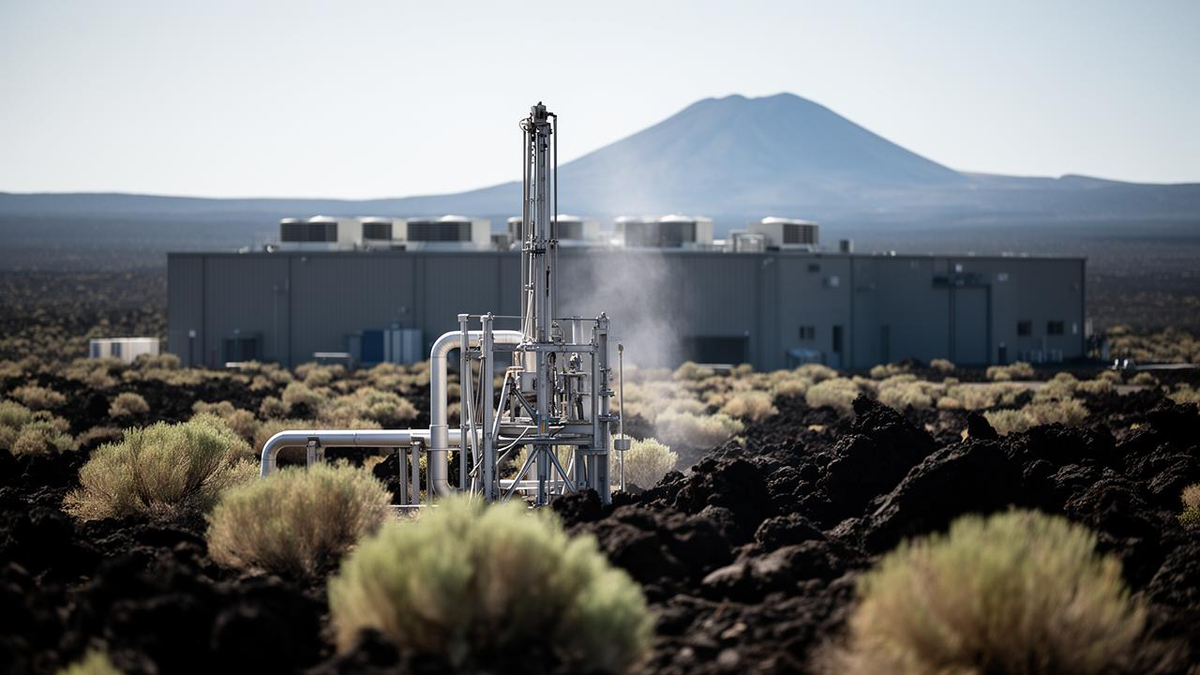
Google has signed a power purchase agreement with geothermal startup Quaise Energy to buy 50 megawatts (MW) of ultra-high-temperature rock geothermal power from its flagship Project Obsidian in central Oregon, with supply starting as early as 2030. It is the world’s first commercial ultra-high-temperature rock geothermal PPA, and it gives this still-early-stage drilling technology its first commercial customer.
The 50 MW will supply Google’s data center in The Dalles, Oregon, and surrounding communities. By scale of electricity use, 50 MW is roughly enough to power 50,000 ordinary households. Against the backdrop of data center power demand growth driven by artificial intelligence and cloud computing, the strategic significance of this contract lies in finding a new source of round-the-clock, carbon-free baseload power.
From natural steam to vaporized rock
Traditional geothermal power relies on natural hot-water or steam reservoirs near the surface, where temperatures rarely exceed 600 degrees Fahrenheit (about 316 degrees Celsius), severely limiting site selection to specific geological conditions. Ultra-high-temperature geothermal requires drilling miles down to reach rock formations approaching 800 degrees Fahrenheit (about 427 degrees Celsius), then injecting cold water to generate steam that drives turbines. Quaise says a single ultra-high-temperature geothermal well can generate up to 10 times the power of a conventional geothermal system, and unlike wind and solar, it is not disrupted by weather, delivering stable output around the clock.
Project Obsidian is located on the southern flank of Newberry Volcano and is being advanced in two phases. The first phase uses conventional drilling technology to develop ultra-high-temperature resources; the second phase plans to deploy millimeter-wave drilling, using high-energy electromagnetic waves to vaporize rock directly, with the drill bit never touching the rock formation. This avoids the problem of frequent bit wear and replacement in hard formations and lowers drilling costs. The technology stems from more than a decade of research at the Massachusetts Institute of Technology (MIT). If successfully deployed, it would be the first time millimeter-wave drilling has been applied to a commercial geothermal project anywhere in the world.
However, the project still requires construction of a transmission line of about 10 miles to connect to a substation in La Pine before it can be formally connected to the grid. The related construction and permitting schedule remains a variable in whether supply can be delivered on time.
CEO sees up to 1 GW within a decade
Quaise CEO and President Carlos Araque estimates that as drilling depth continues to advance, Project Obsidian’s generating capacity could reach about 1 GW (one million kilowatts) over the next decade, equivalent to powering about 1 million households. He also believes the entire Newberry Volcano area has a generating potential of 10 GW. Araque said the project represents the beginning of humanity tapping a vast clean energy source on Earth.
Lucia Tian, Google’s head of advanced energy technologies, acknowledged that costs for such new technologies remain high for now, and that Google’s goal is to drive costs down continuously and achieve long-term widespread adoption. She noted that this kind of round-the-clock, stable, carbon-free baseload power is extremely valuable to the grid and can also bring jobs to local communities.
Quaise completed a $180 million Series B financing round in August this year, with the funds to be used to advance drilling technology and project development.
Geothermal share still low; tech giants race for position
Data from the U.S. Energy Information Administration (EIA) shows that in 2025 only seven states in the United States had geothermal power stations, and geothermal generation accounted for about 0.4% of total U.S. utility-scale electricity generation, still a very low share. At least 20 companies worldwide are developing new geothermal extraction technologies. Quaise’s competitors include Mazama Energy, which is also developing ultra-high-temperature geothermal near Newberry Volcano, and Fervo Energy.
Fervo Energy said in its earnings presentation on the 9th of this month that it had signed what it considers its largest enhanced geothermal PPA to date with Google. Google has continued to expand its clean energy footprint in recent years. The company disclosed that between 2010 and 2025 it signed more than 240 clean energy procurement agreements totaling nearly 35 GW.
Key data for this deal:
Note: Household counts are reference estimates based on average household electricity use as cited by the source; 1 GW is Quaise’s CEO’s estimate of generating capacity over the next decade.
For the market, the significance of this contract is not the 50 MW volume but the establishment of the first commercial outlet for ultra-high-temperature geothermal. Geothermal has baseload characteristics unaffected by weather, which aligns precisely with the 24-hour, uninterrupted power demand curve of AI data centers — explaining why Google, Fervo and others have signed deals密集 in recent months. However, millimeter-wave drilling has not yet entered commercial operation, and the transmission line has yet to be built, so technology and engineering risks remain high. If second-phase drilling validation goes smoothly, the developable area for the geothermal industry will expand substantially beyond a handful of natural steam fields; otherwise, overall commercialization could be delayed.
For Taiwanese investors, the probability of direct near-term benefit is low, but medium- and long-term demand across the geothermal equipment, drilling services and grid engineering supply chains is worth watching. Taiwanese companies that enter segments such as high-temperature-resistant materials, power management and substation equipment may have an opportunity to ride this new geothermal investment cycle.
Once added, BigGo Finance appears first in Google Search Top Stories, so you get the broadest, most up-to-the-minute, and most comprehensive global financial news first.
The news and data on this website are for reference only and do not constitute investment advice or an offer to buy or sell. Information is sourced from exchanges and public sources, and may be delayed, interrupted, or updated. While we strive for accuracy, we do not guarantee timeliness, correctness, or completeness. Content may include external links for which we are not responsible. By using this site, you agree that we and our partners are not liable for any losses. Investment carries full responsibility; please carefully assess risks and consult professionals. If there are errors in the content, please contact us for correction.